
Company Introduction
More









Taimi SSD Technology: Wafer-Level Testing & Signal Integrity for Enterprise SSD Reliability
Share:
In the enterprise world, raw benchmark numbers are just the starting point. They don’t mean much if the drive can’t hold up under 24/7 load or if it’s prone to data corruption. We’re pulling back the curtain on what actually defines reliability—specifically how we handle wafer-level NAND testing and signal integrity in our high-speed drives.
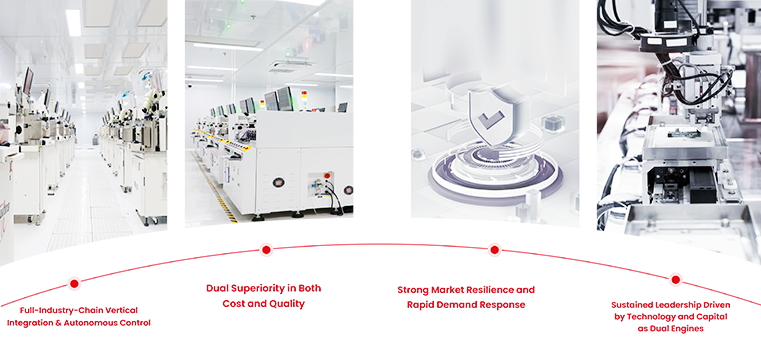
At Taimi, SSD reliability is built from the ground up—from wafer-level NAND screening to high-speed PCB signal integrity validation and firmware-level error correction tuning. Taimi engineering and manufacturing capabilities
This article explains how each stage of our vertically integrated manufacturing process contributes to consistent SSD performance in enterprise and industrial environments.
Why Enterprise SSD Reliability Depends on Manufacturing Quality and Testing
Everyone looks at the sequential speed on the box. But let’s be honest—PCIe 4.0 bandwidth is only useful if the drive can actually sustain it under real, non-stop pressure.
However, in enterprise workloads—such as video rendering, data logging, industrial computing, and system integration—long-term stability is often more important than peak speed.
For users upgrading storage devices, reliability is also important during system migration. If a cloned drive fails to boot after migration, our guide on how to fix a cloned SSD that won’t boot provides practical troubleshooting steps.
SSD reliability is ultimately determined by:
- NAND flash quality consistency
- Signal integrity at high-speed interfaces
- Firmware-level error handling
- Thermal and workload endurance behavior
- PCIe vs SATA SSD comparison
Overlook any of this, and your performance becomes a liability: think random latency spikes, data corruption, and a drive that gives up under pressure.
What Is Wafer-Level Testing in NAND Flash?
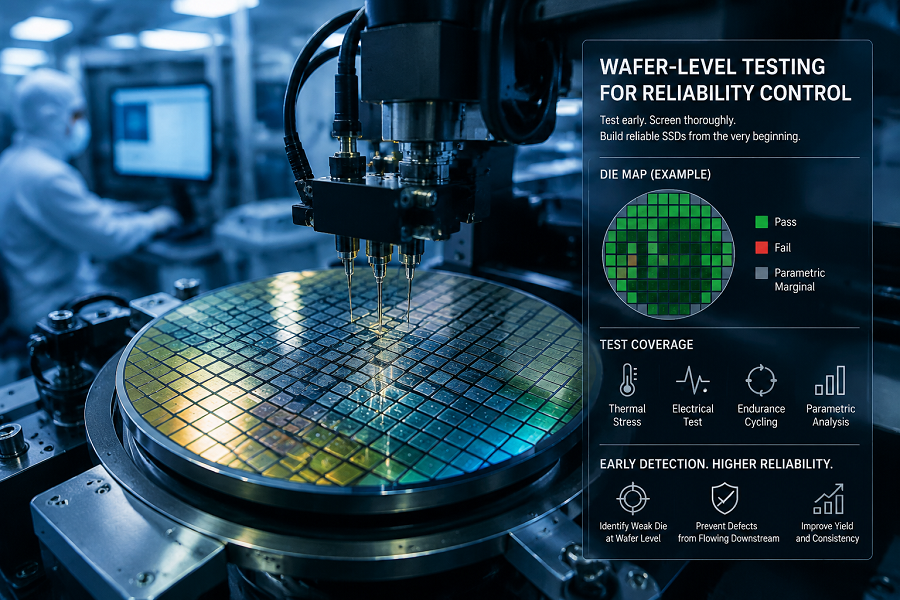
We don't wait for the packaging stage to test our NAND flash. We evaluate it at the wafer level—right on the silicon—so we can weed out unstable dies early.
For enterprise storage inquiries or OEM integration requirements, please contact the Taimi engineering team.
At this stage, each silicon die is tested under controlled electrical, thermal, and parametric conditions to identify early-stage defects. Compared with packaged NAND sampling, wafer-level testing provides earlier visibility into:
- Latent cell instability
- Marginal electrical performance
- Early degradation behavior under stress conditions
Enterprise SSD Validation vs Typical OEM Validation Approach
| Validation Stage | Taimi Factory Process | Typical OEM validation approach |
|---|---|---|
| NAND Screening | Wafer-level stress testing | Packaged NAND sampling only |
| Defect Detection | Early detection of marginal cells | Post-packaging check |
| Thermal Testing | Extended temperature cycling | Basic operational check |
| Signal Integrity | Eye diagram + impedance control | Standard reference layout |
| Firmware Optimization | Tuned LDPC + workload tuning | Generic controller firmware |
Beyond component-level validation, SSD compatibility with different host platforms and operating systems is also critical during real-world deployment. An SSD that is correctly recognized by hardware still needs to communicate properly with the operating system environment. Learn more about SSD recognition issues when an SSD is detected in BIOS but not available in Windows.
Taimi Wafer-Level NAND Screening Process
Taimi implements extended screening procedures during the NAND qualification stage to evaluate consistency under stress conditions. Key validation steps include:
- Thermal stress cycling across extended temperature ranges
- Electrical stability testing under repeated program/erase operations
- Long-duration endurance screening for marginal cell identification
Passing a functional test is the bare minimum. We filter for stability—catching the marginal dies that would inevitably fail once they hit a real-world, high-intensity environment.
Key Engineering Principle: Signal Integrity is a System-Level Constraint
At PCIe 4.0 speeds, signal integrity issues don’t stay at the PCB level. They start to show up in controller response patterns, firmware retry behavior, and latency stability under sustained load.
Why Signal Integrity Matters in PCIe SSD Design
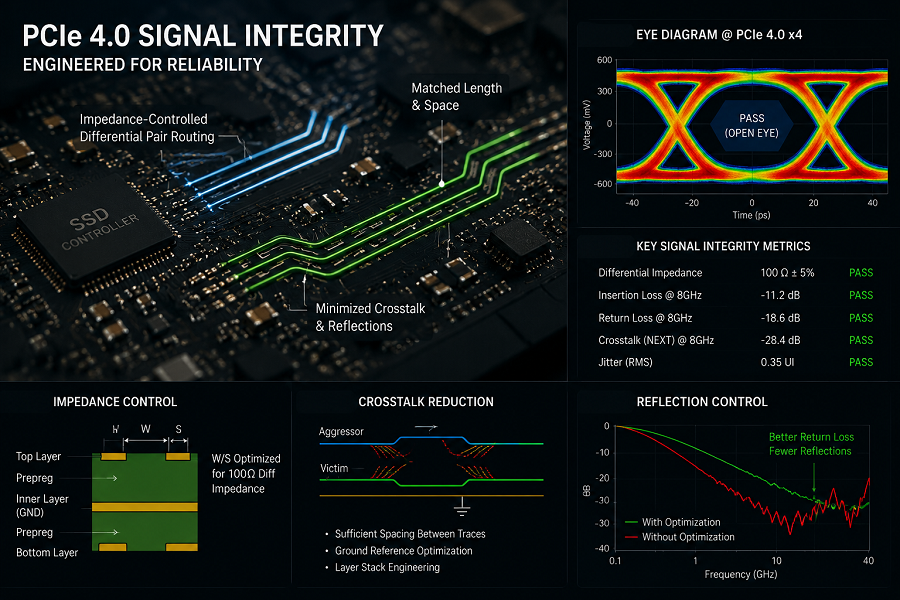
At PCIe 4.0 speeds, 'fast' is easy. The real challenge is keeping the signal clean. If your signal integrity isn't dialed in, the whole drive just struggles to maintain performance.
PCB Design and Validation
Taimi validates high-speed SSD layouts using signal integrity analysis methods, including:
- Impedance-controlled PCB routing
- Eye diagram analysis for signal clarity
- Crosstalk and reflection reduction optimization
Firmware Optimization and Error Correction Strategy
Beyond hardware design, SSD stability also depends heavily on firmware-level management. Taimi SSD firmware is tuned to improve long-term data integrity by optimizing:
- LDPC error correction behavior under NAND wear conditions
- Wear leveling efficiency across flash blocks
- Garbage collection timing under sustained workloads
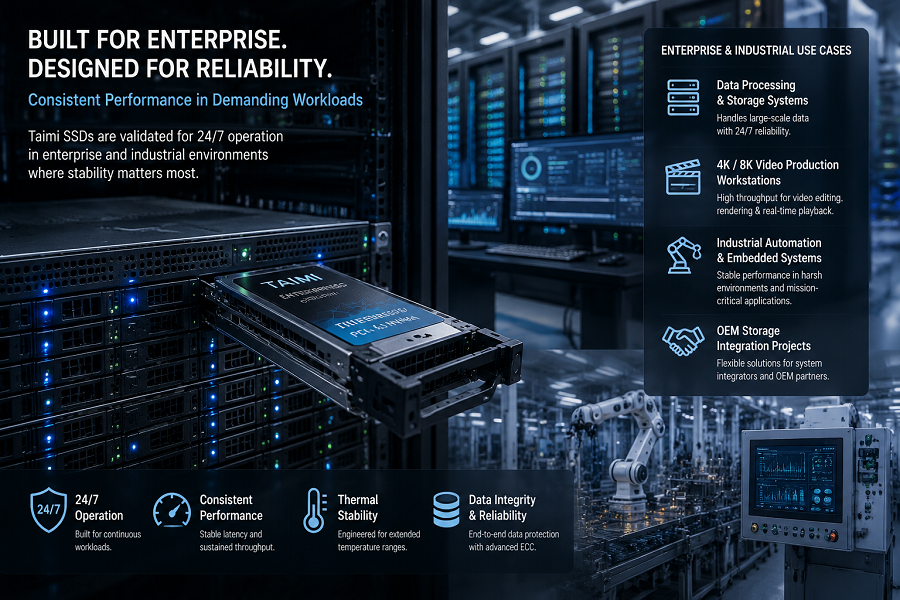
Enterprise and Industrial Use Cases
- Data processing and storage systems
- 4K/8K video production workstations
- Industrial automation and embedded systems
- OEM storage integration projects
Conclusion: Reliability Built from the Inside Out
Taimi’s SSD design philosophy is based on vertical integration. We integrate wafer-level testing, signal validation, and firmware tuning into one workflow. This approach helps ensure consistent performance across production batches over time.
These practices are aligned with enterprise storage requirements in industrial and OEM environments.
FAQ
Q1: Why not rely on post-packaging NAND testing alone?
Most manufacturers wait until the chips are packaged to test them. We don't. By catching weak NAND dies at the wafer level, we filter out unreliable silicon before it ever reaches the SMT line.
Q2: Does signal integrity really change anything for the end user?
At PCIe 4.0 speeds, minor signal integrity issues can amplify into retransmission overhead and latency instability under load. This is why we validate each signal path to maintain stable behavior in sustained operation.
Q3: How does your enterprise validation stack up against standard consumer testing?
The difference lies in validation depth, workload duration, and system-level stress simulation. Our process mimics real-world enterprise workloads—we’re talking extended thermal stress and long-duration endurance loops. We’re building for stability, not just for a spec sheet.
Q4: Why focus so much on firmware tuning?
Hardware is just the vessel. If the firmware is generic, performance drops off a cliff as the drive fills up. Our custom tuning keeps your IOPS consistent, no matter how hard you’re pushing it.
Q5: What workloads are Taimi SSDs optimized for?
Taimi SSDs are optimized for sustained workloads such as video production, industrial systems, data processing, and OEM integration projects requiring consistent performance.
For OEM integration or enterprise storage requirements, contact the Taimi engineering team for technical evaluation.
Related Products
Recommended Articles
Taimi @ Global Sources Hong Kong 2026: The Technical Recap
2026-06-25
More
7000MB/s Peak Read vs. Sustained Write Lines in 4K Video Workflows
2026-04-24
More
SVIAZ 2026 Recap: Moscow, Data, and Our Manufacturing Reality
2026-04-02
More
Laptop Still Slow? Stop Blaming the CPU and Fix Your Storage (2026)
2026-04-23
More
PCIe 4.0 vs. SATA SSD: Choosing the Right Storage for OEM Projects (No Fluff)
2026-06-26
More
Taimi’s Integrated Manufacturing Strategy: Insights from Eletrolar Show 2026
2026-06-24
More