
















A clear SSD order confirmation helps both parties work from the same requirements. It can reduce misunderstandings, prevent avoidable specification changes, and make it easier to check whether the delivered products match the approved order.
This guide explains what to include in an SSD order confirmation and provides a practical checklist for distributors, PC builders, system integrators, and OEM buyers.
Before confirming a bulk SSD order, buyers should also understand how to evaluate potential suppliers. See our guide on How to Choose an SSD Supplier in China: A Practical Buyer's Guide for a practical approach to supplier evaluation.
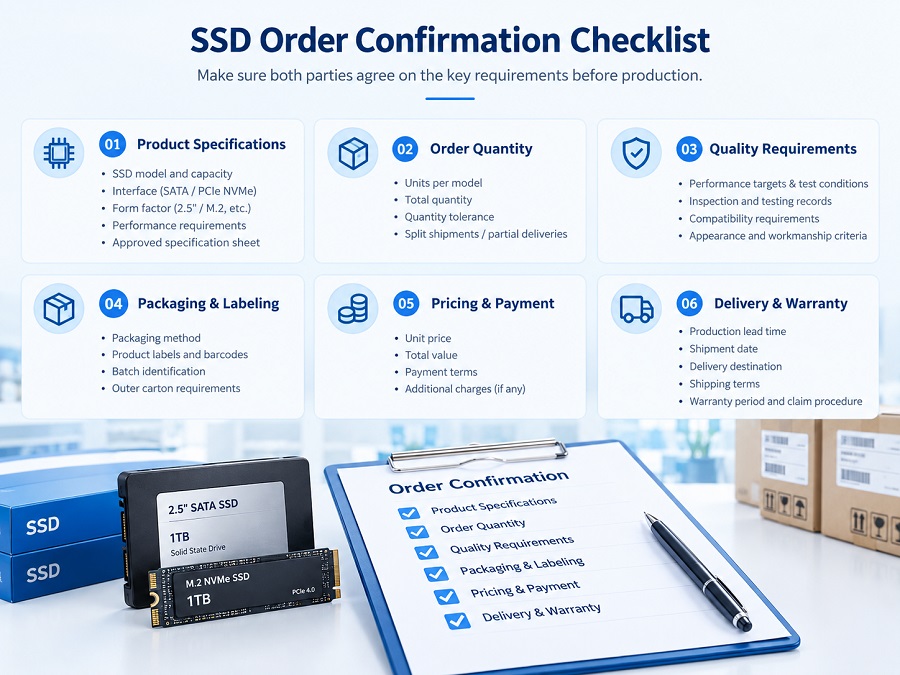
Quick Answer: What Should an SSD Order Confirmation Include?
An SSD order confirmation should document the key product, quality, commercial, and delivery requirements agreed upon by the buyer and supplier.
| Confirmation Item | What to Check |
|---|---|
| Product details | SSD model, capacity, interface, form factor, and approved specification |
| Order quantity | Units per model, total quantity, and any agreed quantity tolerance |
| Technical requirements | Performance targets, compatibility requirements, and applicable acceptance criteria |
| Quality and packaging | Inspection requirements, packaging method, labels, and batch identification |
| Commercial terms | Unit price, total value, payment terms, and additional charges |
| Delivery arrangements | Production lead time, shipment date, delivery destination, and agreed shipping terms |
| Warranty and support | Warranty period, claim procedure, and responsibilities of each party |
| Document control | Order number, specification version, revision date, and written approval |
The exact requirements depend on the product and agreement. For bulk SSD procurement, the most important point is to ensure that both parties are referring to the same approved specifications before production begins.
1. Confirm Product Specifications, Models, and Quantities
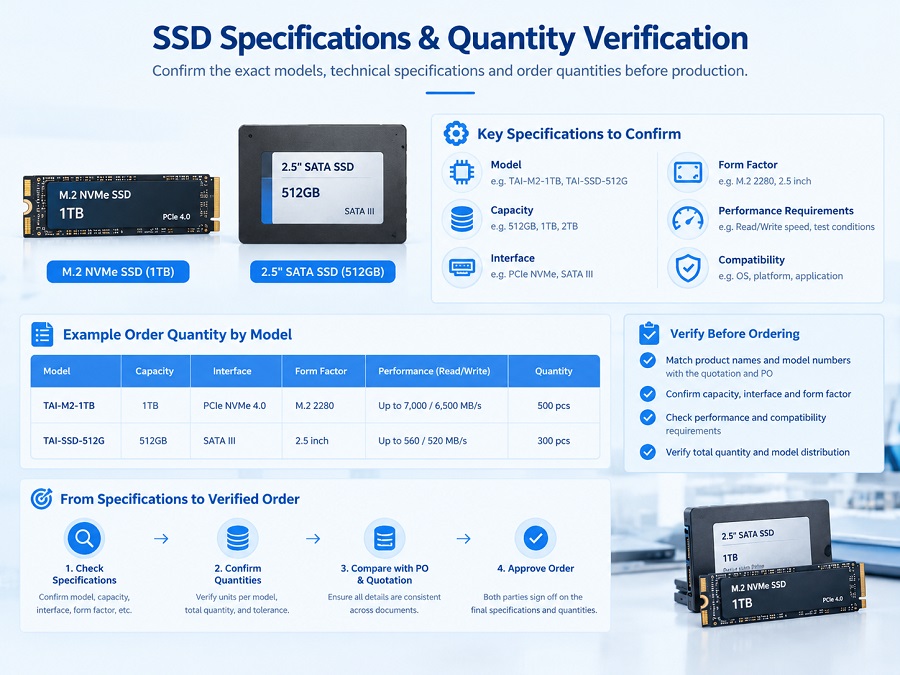
Product specifications should be clearly documented in the order confirmation rather than left to assumptions or informal conversations. Even when the buyer and supplier have discussed the requirements in advance, the final confirmation should identify the exact product being ordered.
Confirm the SSD Model and Technical Requirements
For each SSD model, check the following information where applicable:
- Capacity: Such as 256GB, 512GB, or 1TB.
- Interface: Such as SATA or PCIe NVMe.
- Form factor: Such as 2.5-inch or M.2, including the required dimensions where relevant.
- Performance requirements: Read and write targets, together with the agreed testing conditions.
- Compatibility requirements: The intended host platform, operating system, or application requirements where relevant.
- Approved specification: The latest specification sheet or other document accepted by both parties.
For example, an order for a 1TB M.2 NVMe SSD should not rely on capacity alone. The buyer and supplier should also confirm the required interface, physical dimensions, performance expectations, and product model.
Not every order needs to specify every internal component. If the buyer requires a particular NAND type, controller, firmware version, or other component, that requirement should be documented explicitly. If substitutions are permitted, the conditions for approval should also be clear.
For more background on how firmware affects an SSD product, see What Is SSD Firmware? How It Impacts Performance, Compatibility, and Reliability.
Verify Quantities and Model Distribution
For orders containing multiple SSD models or capacities, list the quantity of each item separately. Confirm the total quantity and any agreed arrangements for split shipments or partial deliveries.
For example, an order may include 500 units of a 512GB SSD and 300 units of a 1TB SSD. Listing each model separately makes it easier to verify production quantities, shipping documents, and the final invoice.
Before approving the order, check that the product names, model numbers, capacities, and quantities match the quotation and the buyer's purchase order (PO).
2. Document Quality Requirements, Packaging, and Labeling
A bulk order should define how the products are expected to be supplied and which agreed requirements will be used for acceptance. This helps avoid disagreements after the goods are ready for shipment.
Record the Agreed Quality Requirements
The order confirmation should reference the approved specification and any applicable quality requirements. Depending on the project, these may include:
- Agreed performance targets and test conditions.
- Required functional testing or inspection records.
- System or platform compatibility requirements.
- Product appearance and workmanship criteria.
- Any special inspection, reporting, or documentation requirements.
If sample validation has already been completed, identify the approved sample or specification version where practical. This gives both parties a clear reference for the production order.
Avoid using vague wording such as "high quality" as the only acceptance requirement. Specific, agreed criteria are easier to review than subjective descriptions.
The confirmation does not need to reproduce the supplier's entire quality-control process. It should identify the requirements that matter to the buyer and explain which approved documents govern the order.
Confirm Packaging and Labeling Details
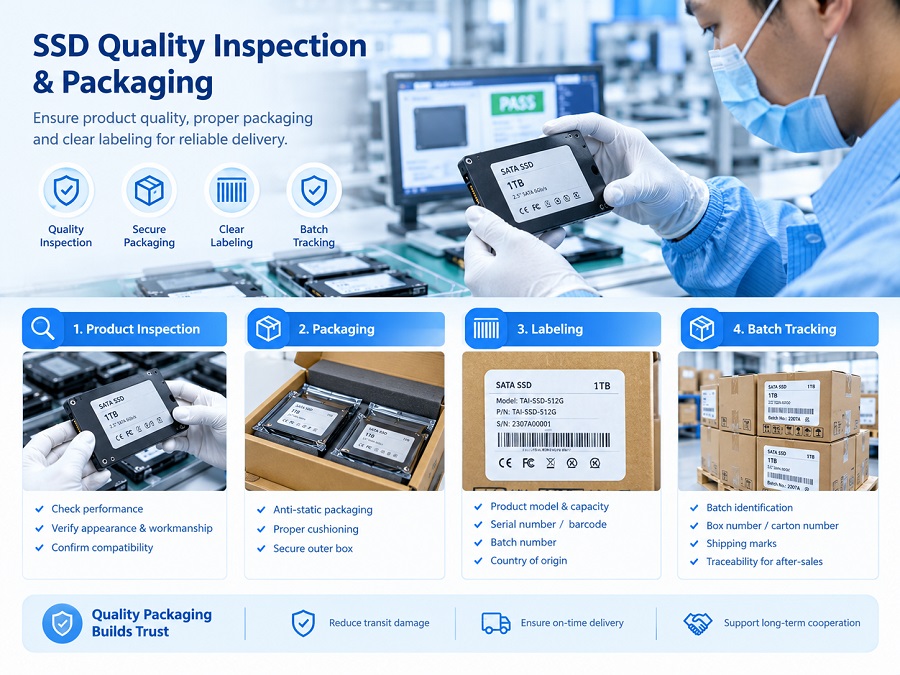
Packaging and labeling requirements can affect warehouse receiving, inventory management, and resale preparation. Confirm these details before production or packing begins.
Depending on the order, check:
- Whether each SSD requires an individual box, blister pack, or another agreed package.
- Whether product labels must show the model, capacity, barcode, or other information.
- Whether serial numbers or batch identifiers are required.
- Whether retail packaging, neutral packaging, or OEM branding will be used.
- How products should be packed into inner boxes and outer cartons.
- Whether carton labels or packing lists need to follow a specific format.
For OEM or private-label orders, approve the label artwork and packaging layout before mass production. This reduces the risk of incorrect logos, model names, barcodes, or other printed information appearing on the finished products.
Where serial-number or batch traceability is required, specify the expected information and how it should appear in the relevant records. Do not assume that every order automatically includes the same traceability arrangements.
3. Confirm Pricing, Delivery, Warranty, and Commercial Terms
Product requirements are only one part of a complete order confirmation. Buyers should also ensure that the commercial terms match the quotation and purchase order.
Verify Pricing and Payment Terms
Check the agreed unit price for each model, the total order value, currency, payment schedule, and any additional charges.
If the order includes customized packaging, labels, tooling, or other special requirements, confirm whether these costs are included in the quoted price or charged separately.
The confirmation should also make clear whether the agreed price applies to the entire order or to a specific quantity tier. This is especially important when the buyer expects to place repeat orders at different volumes.
Confirm Production Lead Time and Shipment Arrangements
The order confirmation should distinguish between the expected production schedule and the shipment arrangements.
Confirm the following items as applicable:
- Expected production lead time and planned completion date.
- Target shipment date or agreed delivery schedule.
- Delivery destination and shipping method.
- Agreed shipping terms and the party responsible for freight and related charges.
- Required shipping documents, such as the packing list and commercial invoice.
- Whether partial shipments are permitted.
For example, if a buyer needs SSDs for a scheduled PC assembly project, an unclear delivery date can create problems even when the product specifications and price are correct.
If delivery depends on artwork approval, sample approval, deposit receipt, or another milestone, identify that dependency in the order documents. This helps both parties understand what needs to happen before the schedule can proceed.
Record Warranty and After-Sales Arrangements
Warranty terms should be confirmed before the order is finalized. The relevant details may include:
- The applicable warranty period.
- The event or date from which the warranty period begins, as agreed.
- The process for reporting defective products.
- The information required for a warranty claim.
- The agreed procedure for assessment, replacement, or other remedies.
- The contact point for after-sales support.
Buyers should confirm the actual warranty terms offered for the products rather than assume that all SSD models or suppliers have identical policies.
Clear documentation helps both parties understand their responsibilities if a product issue arises after delivery.
4. How to Manage Order Changes After Confirmation
An order confirmation should serve as a reliable reference for production and delivery. If a requirement changes after approval, the change should be documented instead of relying on an informal message alone.
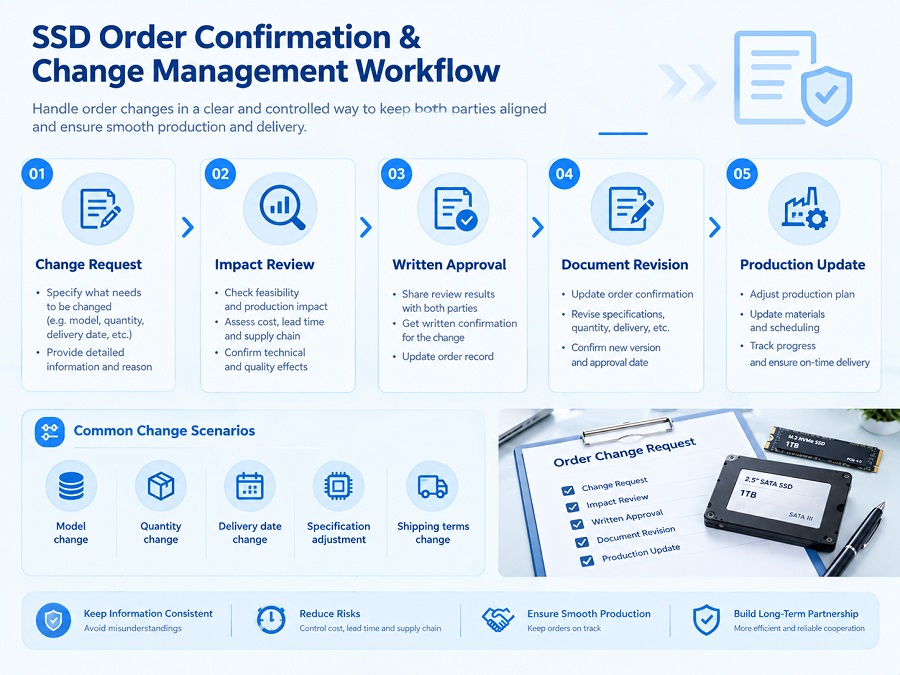
A practical change-management process includes four steps.
Step 1: Submit the Change Request
The buyer should identify the affected item, the requested change, and the reason for the request. Examples include changing the quantity, updating a label, revising the delivery schedule, or modifying an agreed technical requirement.
Step 2: Review the Impact
The buyer and supplier should assess whether the change affects cost, materials, production progress, testing, packaging, or shipment timing. Not every change can be made without affecting the existing schedule.
Step 3: Obtain Written Approval
Both parties should approve the revised requirements and any changes to price or delivery terms before proceeding. For technical changes, the parties should also determine whether a new sample or additional validation is necessary.
Step 4: Update the Order Records
Record the new revision, approval date, and affected documents. Make sure the teams responsible for production, inspection, packing, and shipping are working from the latest approved version.
For example, changing an SSD label may require updated artwork and packing instructions. Changing a technical specification may require a more extensive review before production can continue.
The level of review should match the impact of the change. The goal is to prevent outdated instructions from being used during production or shipment.
SSD Order Confirmation Checklist for Bulk Buyers
Before approving a bulk SSD order, use the following checklist to review the essential information.
Product and specifications
- The SSD model, capacity, interface, and form factor are correct.
- The quantity for each model and the total order quantity are confirmed.
- The applicable technical specification and acceptance requirements are identified.
- Any special component, firmware, or compatibility requirements are documented where applicable.
Quality and packaging
- Packaging, labeling, branding, and barcode requirements are approved.
- Required inspection records and batch information are specified where needed.
Commercial and delivery terms
- Unit prices, total value, currency, and payment terms are confirmed.
- Production lead time, shipment arrangements, and delivery destination are agreed upon.
- Warranty terms and the after-sales claim procedure are documented.
Final approval
- The purchase order and order confirmation refer to the same approved requirements.
- Any exceptions, changes, or special arrangements have written approval.
- Both parties have retained the final approved order documents.
A completed checklist does not replace a formal purchase order or contract. It helps buyers identify missing information before the order moves forward.
Planning a Bulk SSD Order? Talk to Taimi
For distributors, PC builders, system integrators, and OEM buyers, clear order documentation is an important part of managing bulk SSD procurement.
Taimi works with customers on SSD product requirements, specification confirmation, and bulk-order arrangements. If you are planning an order, share your target models, capacities, quantities, and any special requirements so the details can be reviewed before confirmation.
Planning your next bulk SSD order?
Discuss Your SSD Order RequirementsFrequently Asked Questions
Author: Taimi Technical Team