
Company Introduction
More















UFS vs eMMC: Speed, Performance, Versions, and Key Differences
Share:
Quick Answer
UFS (Universal Flash Storage) generally provides higher storage performance than eMMC (embedded MultiMediaCard), especially for random read/write operations, multitasking, and applications that require frequent data access. UFS uses a more advanced serial interface and supports features such as command queuing and full-duplex communication.
eMMC, however, remains a practical and cost-effective storage solution for many embedded devices because it integrates NAND flash and a controller into a compact package, providing sufficient performance for many applications.
| Requirement | Typical Choice |
|---|---|
| Lower storage cost | eMMC |
| Basic embedded storage | eMMC |
| Higher random performance | UFS |
| Faster application loading | UFS |
| Heavy multitasking | UFS |
| Cost-sensitive products | eMMC |
| Higher-performance mobile or embedded devices | UFS |
The right choice depends on the device's performance requirements, system architecture, compatibility, capacity, power requirements, and total product cost.
What Is eMMC?
What Does eMMC Mean?
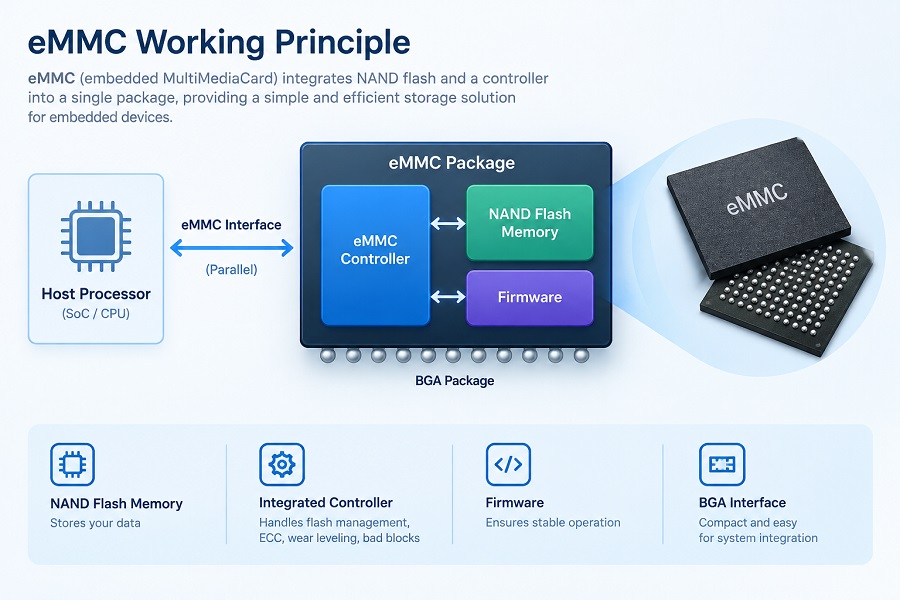
eMMC stands for embedded MultiMediaCard. It is a type of embedded storage that combines NAND flash memory and a flash memory controller into a single integrated package, such as BGA153 packages used by many eMMC devices.
This integrated design simplifies storage implementation for device manufacturers. Instead of managing raw NAND flash, wear leveling, and bad blocks directly, the host system communicates with the eMMC device through a standardized interface.
For a foundational understanding of embedded media card standards, read our guide on What Is eMMC?
How Does eMMC Work?
An eMMC device typically contains:
- NAND flash memory
- An integrated flash controller
- Firmware
- A standardized BGA interface
Depending on the product design, eMMC may use different NAND configurations. The controller manages essential storage operations such as flash management, error correction (ECC), bad-block management, and wear management. Learn more about the underlying storage technology in our detailed article on What Is NAND Flash?
Because the controller and NAND are integrated into one package, eMMC can be relatively simple to implement in embedded products. eMMC has been widely used in smart home devices, set-top boxes, automotive electronics, tablets, and consumer electronics.
What Is UFS?
What Does UFS Mean?
UFS stands for Universal Flash Storage. It is an embedded storage standard designed to provide higher performance and more advanced data-transfer capabilities than earlier embedded storage technologies.
UFS is commonly associated with smartphones, edge devices, and other applications that require faster storage performance. For a deeper look at the technology, see our dedicated guide on What Is UFS?
How Does UFS Work?
UFS uses a high-speed serial interface and supports more advanced communication between the host processor and storage device.
One important difference is that UFS supports full-duplex communication, allowing data to be read and written at the same time under supported operating conditions. UFS also supports advanced command queuing, which allows multiple storage commands to be managed more efficiently.
These architectural differences can provide advantages in random access, multitasking, application loading, and other workloads involving frequent storage operations.
UFS vs eMMC: Key Differences
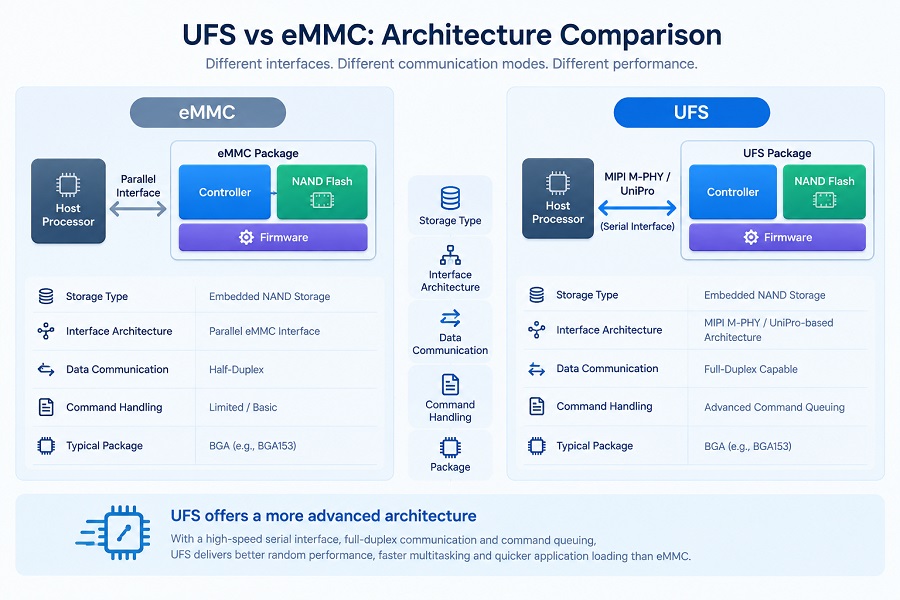
The biggest difference between UFS and eMMC is not simply the theoretical transfer rate. Their interface architectures and command-handling capabilities are also different.
| Feature | eMMC | UFS |
|---|---|---|
| Storage Type | Embedded NAND Storage | Embedded NAND Storage |
| Interface Architecture | Parallel eMMC Interface | MIPI M-PHY / UniPro-based Architecture |
| Data Communication | Half-Duplex | Full-Duplex Capable |
| Command Handling | Limited / Basic | Advanced Command Queuing |
| Random Performance | Generally Lower | Generally Higher |
| Sequential Performance | Moderate to High | Higher in Newer Generations |
| Multitasking | Suitable for Moderate Workloads | Better Suited to Intensive Workloads |
| Cost Profile | Generally Lower | Generally Higher |
| Design Complexity | Relatively Simple | More Advanced |
| Typical Applications | Cost-Sensitive Embedded Devices | Higher-Performance Mobile and Embedded Devices |
The actual performance of an individual product depends on its NAND flash, controller, firmware, capacity, thermal conditions, host platform, and other design factors.
UFS vs eMMC Speed: How Much Faster Is UFS?
Sequential Read and Write
Sequential read and write performance measures how quickly a storage device can transfer relatively large blocks of continuous data. This affects tasks such as large file transfers, high-definition video file operations, system image updates, and large application installations.
Newer generations of UFS generally provide significantly higher sequential bandwidth than older eMMC generations. However, a product's real-world sequential performance also depends on NAND flash quality, controller design, firmware, thermal conditions, capacity, and host-system limitations.
Random Read and Write
Random performance is particularly important for everyday device responsiveness. Small storage operations are common when booting the operating system, opening applications, loading system files, updating application data, and accessing many small files.
UFS is designed to handle these workloads more efficiently than traditional eMMC architectures.
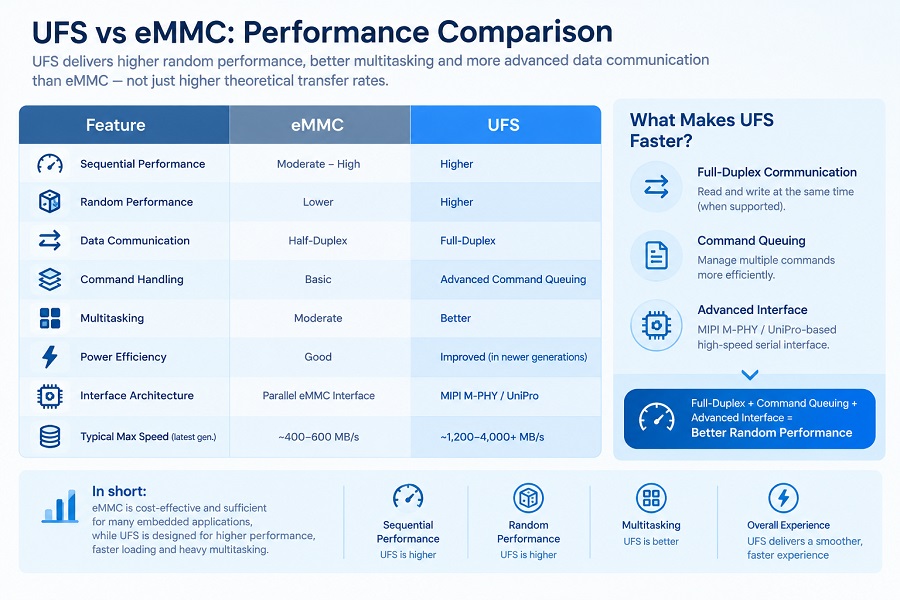
Why Is UFS Faster?
- Full-Duplex Communication: Simultaneous bidirectional data transfer can reduce the overhead associated with switching between read and write operations.
- Command Queuing: Advanced command management allows multiple storage requests to be processed concurrently and efficiently.
- Advanced Interface Architecture: Serial interface architecture based on MIPI M-PHY and UniPro technologies supports higher-performance applications.
UFS and eMMC Versions Explained
eMMC Versions
- eMMC 4.x / 5.0: Earlier-generation embedded storage.
- eMMC 5.1: Mature and widely used generation for smart devices, consumer electronics, and embedded products.
Taimi eMMC 5.1 Solutions at a Glance
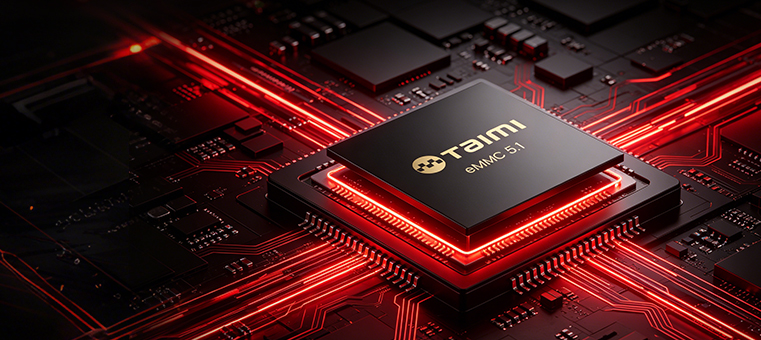
Taimi provides eMMC 5.1 storage solutions for embedded and consumer electronics applications, with BGA153 packaging and capacities from 4GB to 128GB. Products are supported by a 3-year limited warranty.
UFS Versions
| UFS Version | General Positioning |
|---|---|
| UFS 2.0 | Earlier UFS generation for older mobile and embedded devices |
| UFS 2.1 | Improved features and performance for mainstream applications |
| UFS 3.0 | Major generation upgrade for high-performance devices |
| UFS 3.1 | Further performance and feature improvements for modern applications |
| UFS 4.0 | Newer high-performance generation for high-end smartphones and systems |
| UFS 4.1 | Newer-generation improvements for emerging high-performance applications |
Two products using the same UFS or eMMC generation can have different performance levels due to differences in NAND flash quality, controller design, firmware, capacity, and host platform optimization.
UFS vs eMMC: Performance in Real-World Workloads
- Boot Time: UFS can provide advantages in storage-heavy boot workloads, particularly when the system needs to access many files during startup. However, overall boot time also depends on the processor, firmware, memory, and OS optimization.
- App Loading & Multitasking: Applications require many small files to be accessed during startup. Because UFS provides stronger random-access capabilities and command queuing, it handles multitasking and app loading more efficiently.
- Power Efficiency: Power consumption should be evaluated together with performance. A storage device that completes a workload more quickly may return to sleep mode faster, affecting overall energy consumption depending on the specific workload.
UFS or eMMC? Quick Decision Guide
| Product Requirement | Storage Direction |
|---|---|
| Basic embedded storage | eMMC |
| Cost-sensitive product | eMMC |
| Moderate storage workload | eMMC |
| Higher random I/O requirements | UFS |
| Heavy multitasking | UFS |
| Faster application loading | UFS |
| High-performance mobile device | UFS |
| Existing eMMC-based design | Evaluate eMMC first |
What Should Buyers Check When Sourcing UFS or eMMC?
1. Storage Capacity & Options
Confirm required capacities and standard package formats. Depending on the application, buyers may require different capacity tiers across product lines.
2. NAND Flash Type & Quality
NAND flash directly impacts storage performance, endurance, cost, and consistency. Understand the NAND configuration, supplier source, and expected endurance.
3. Controller & Firmware
Different controller solutions and firmware configurations produce different performance, power management, and compatibility characteristics even on the same interface standard.
4. Manufacturing Control & Testing
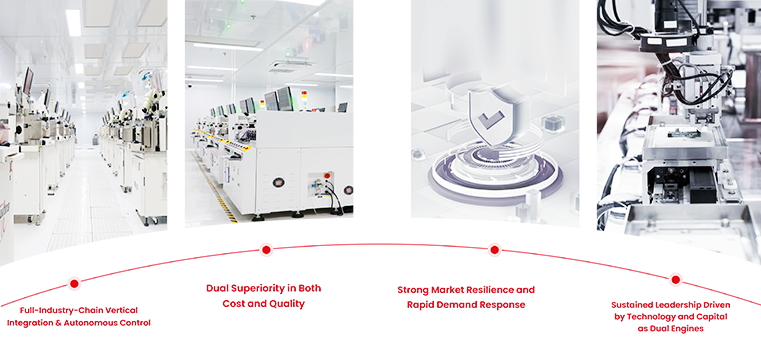
For bulk procurement, maintaining consistent specifications across production batches is important. At Taimi, manufacturing quality is maintained through in-house processes including SMT assembly lines, Die testing, wafer dicing and bonding, high-temperature burn-in testing, and standardized packaging.
5. Compatibility & Sample Validation
Before placing large orders, evaluate samples on the actual target platform to verify host processor compatibility, boot stability, and power behavior.
6. Warranty Terms & Support
Clear warranty terms reduce sourcing risks. All Taimi storage lines—including eMMC, PCIe 3.0/4.0/5.0 NVMe SSDs, 2.5-inch SATA, M.2 SATA, mSATA, and Micro SD cards—come with a 3-year limited warranty.
Frequently Asked Questions (FAQs)
Is UFS faster than eMMC?
Yes. UFS generally delivers higher storage performance than eMMC, particularly for random read/write workloads and multitasking. UFS uses a high-speed serial interface, supports full-duplex communication under supported conditions, and includes advanced command queuing.
Which is better, UFS or eMMC?
Neither is universally "better"—the right choice depends on your application. UFS is better suited for high-performance applications, heavy multitasking, and devices requiring fast application load times. eMMC is a practical choice for cost-sensitive embedded applications and mainstream electronics where moderate storage performance is sufficient.
What is the difference between UFS 3.1 and eMMC 5.1?
UFS 3.1 and eMMC 5.1 represent different generations and architectures of embedded storage. UFS 3.1 utilizes a high-speed serial bus with full-duplex communication and command queuing designed for high-performance mobile and edge systems. eMMC 5.1 uses a mature parallel bus architecture that is cost-effective and simpler to integrate into mainstream embedded systems.
Is UFS more expensive than eMMC?
Generally, yes. UFS storage devices and their corresponding host platform designs are typically more expensive than eMMC solutions due to more complex controller architectures, higher-performance interfaces, and advanced signal routing requirements.
Can eMMC be replaced with UFS?
eMMC cannot be directly swapped with UFS on the same PCB layout. They use different bus interfaces, physical pinouts, and host controller protocols. Upgrading from eMMC to UFS requires a redesign of the host platform and PCB.
Which is better for embedded devices, UFS or eMMC?
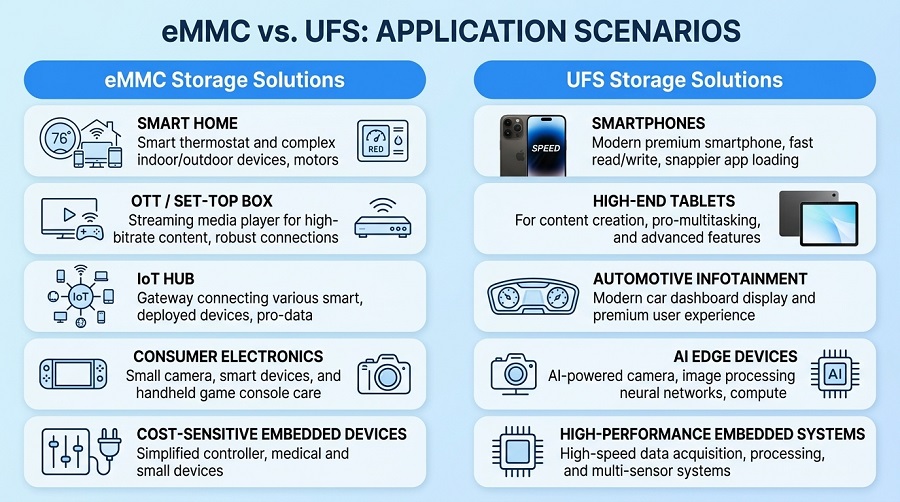
eMMC remains a practical choice for embedded devices with moderate performance requirements, strict BOM budget limits, or simpler system architectures, such as OTT boxes, IoT hubs, and smart home appliances. UFS is suited to advanced embedded devices, such as automotive infotainment, AI edge devices, and high-end tablets, where random access speed and intensive data processing are required.
Conclusion
UFS and eMMC are both embedded storage technologies designed to address different performance and system requirements. UFS generally provides higher storage performance and advanced serial communication, making it suitable for high-performance smartphones and demanding embedded applications.
eMMC 5.1 remains a practical, cost-effective, and relatively easy-to-integrate option for many embedded and consumer electronics applications where moderate storage performance is sufficient.
When choosing between UFS and eMMC, buyers should evaluate the complete product specification—including NAND flash, controller, firmware, sample testing, and manufacturing quality control.
Need UFS or eMMC Solutions for Your Next Project?
Looking for eMMC, UFS, or SSD storage solutions for bulk procurement or OEM projects?
✓ Broad Storage Product Line: eMMC 5.1 (4GB to 128GB), UFS, PCIe 3.0/4.0/5.0 NVMe SSDs, 2.5" SATA, M.2 SATA, mSATA, and Micro SD cards.
✓ Quality Assurance: Strict burn-in testing, SMT assembly control, and a 3-year limited warranty.
✓ OEM/ODM Services: Custom firmware support, private labeling, packaging, and engineering sample evaluation.
Related Products
Recommended Articles
What Is an M.2 SSD? Form Factors, Keys & NVMe vs SATA Explained (2026 Guide)
2026-09-18
More
What Is UFS Storage? Speed, Versions, and OEM Selection Guide
2026-09-14
More
What Is NAND Flash? Types, Speed, Endurance, and Applications Explained
2026-09-10
More
What Is eMMC? Everything You Need to Know About eMMC Storage
2026-09-04
More
How to Evaluate an SSD Supplier: A Checklist for Bulk Buyers
2026-09-02
More
How Much SSD Storage Do You Need? 512GB vs. 1TB vs. 2TB SSD
2026-08-24
More
What Is a PCIe SSD? Speed, NVMe, and Compatibility Guide (2026)
2026-08-19
More
What Is a SATA SSD? Speed, Benefits, Compatibility, and Applications (2026 Guide)
2026-08-14
More