
Company Introduction
More














How to Choose a 2.5-Inch SATA SSD Supplier for Bulk Orders
Share:
Quick Answer
When buying 2.5-inch SATA SSDs in bulk for PC assembly, system integration, or distribution projects, procurement and engineering teams should look beyond unit price. The total project cost, deployment stability, and long-term supply consistency depend on product consistency, real-world write performance, target platform compatibility, and factory quality control.
Before approving a supplier for a bulk purchase order, verify these key checkpoints:
- Physical & Interface Specs: 2.5-inch form factor, 7mm thickness, and SATA III 6Gb/s platform compatibility.
- Hardware Configuration: Approved controller model, defined NAND flash configuration, and controlled firmware revision.
- Performance Testing: Real-world sustained write performance after SLC cache exhaustion, random IOPS, and system stability.
- Batch Consistency: Supplier control over component modifications between sample approval and mass production batches.
- Supply & Support: Minimum order quantities (MOQs), production lead times, batch traceability, and warranty RMA terms.
1. Why Bulk 2.5-Inch SATA SSD Procurement Requires More Than Price Comparisons
The 2.5-inch SATA SSD remains widely used in desktop PCs, laptops, point-of-sale (POS) systems, embedded solutions, and system upgrades. While the physical form factor and SATA interface are standardized, the internal configuration can vary significantly between suppliers.
Two 1TB 2.5-inch SATA SSDs with similar external labeling may have different internal architectures:
| Parameter | Standard Market Drive | Controlled OEM Configuration |
|---|---|---|
| NAND Flash | Variable or mixed-lot flash configuration | Controlled, qualified NAND flash configuration |
| Controller | Variable DRAM-less or entry-level controller | Approved controller model with locked FW revision |
| Manufacturing | Outsourced assembly / varying QC standards | In-house SMT assembly & automated testing process |
| Sustained Write | May vary after cache is filled | Sustained write behavior validated against project requirements |
| BOM Lifecycle | Component changes may occur across batches | Controlled BOM configuration with clear change communication |
For single-unit retail purchases, small differences in performance or components may go unnoticed. For bulk buyers, PC builders, and system integrators installing hundreds or thousands of drives, an unannounced change in controller or NAND flash can lead to OS deployment errors, system instability, or higher warranty return rates.
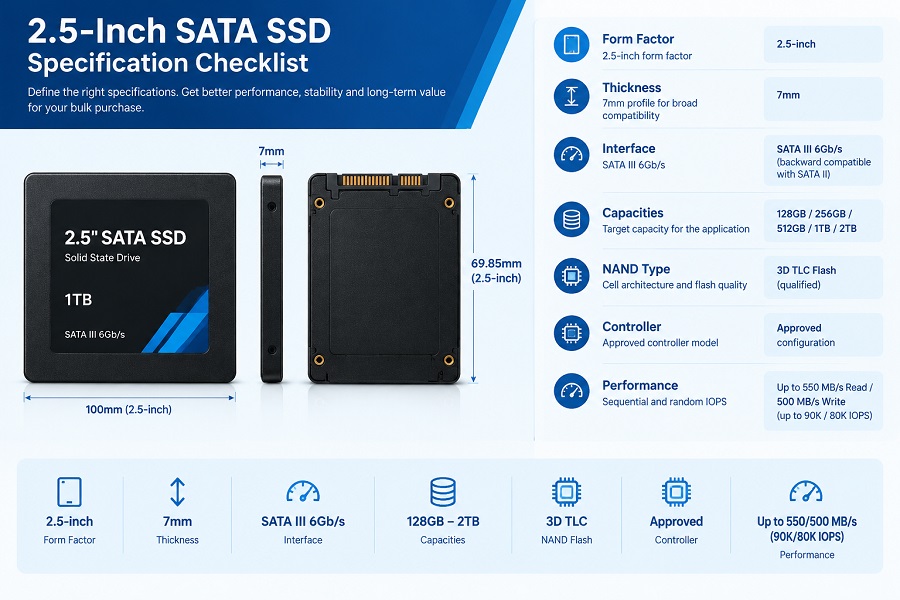
2. 2.5-Inch SATA SSD Specification Checklist
Before requesting quotations or issuing a Request for Quotation (RFQ), define the product specification as clearly as possible.
For a foundational overview of SATA interface standards and compatibility, see:
👉 What Is a SATA SSD? Speed, Benefits, Compatibility, and Applications
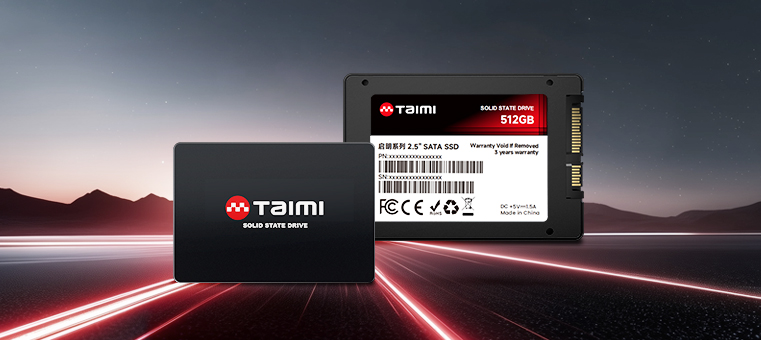
Taimi 2.5-Inch SATA SSD Reference Specification
Use this specification checklist when evaluating SSD suppliers or setting procurement criteria:
| Specification | What Buyers Should Confirm | Taimi 2.5" SATA SSD Reference Specs |
|---|---|---|
| Form Factor | 2.5-inch form factor | Standard 2.5-inch |
| Thickness | 7mm profile for broad compatibility | 7mm (fits thin laptops, desktop bays, and enclosures) |
| Interface | SATA III 6Gb/s | SATA III 6Gb/s (backward compatible with SATA II) |
| Capacities | Target capacity for the application | 128GB, 256GB, 512GB, 1TB, 2TB |
| NAND Type | Cell architecture and flash quality | Qualified 3D TLC Flash configuration |
| Controller | Approved controller model | Approved controller configuration |
| Seq. Read / Write | Target sequential performance | Up to 550 MB/s Read / 500 MB/s Write |
| Random IOPS | Small-file and system responsiveness | Up to 90,000 Read IOPS / 80,000 Write IOPS |
| Quality Control | Factory screening and testing | SMT inline inspection & high-temp burn-in testing |
| Warranty | Terms and RMA support structure | 3-Year Limited Warranty with technical support |
Note: Sequential and random performance targets should be confirmed based on the selected model and project requirements.
3. Auditing the Internal Hardware Configuration: NAND, Controller & Firmware
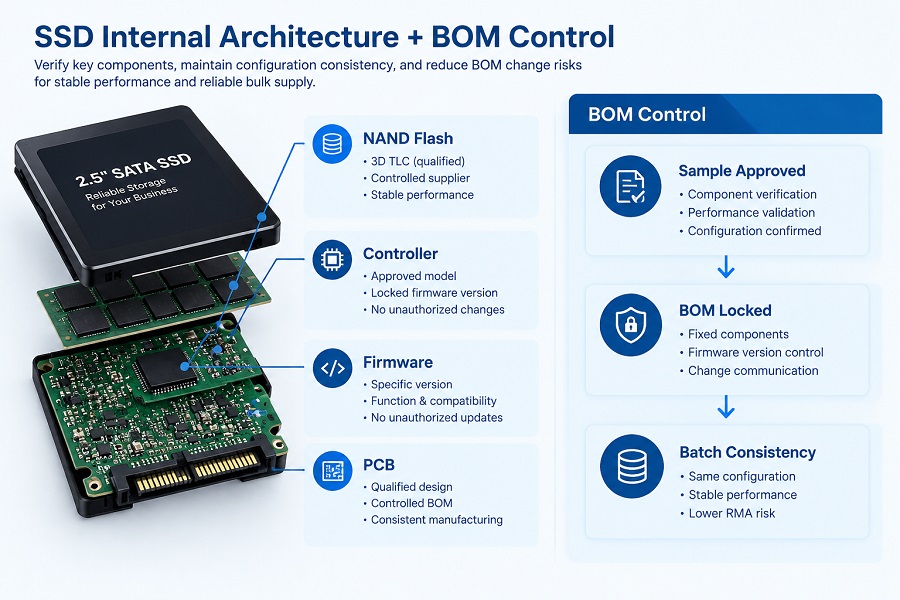
An advertised capacity (such as 512GB or 1TB) and SATA interface speed do not fully describe a drive's internal architecture. Bulk buyers should request clear details on three core internal components:
3.1 NAND Flash
NAND flash memory directly influences write behavior, drive endurance, and long-term stability.
- TLC vs. QLC: 3D TLC (Triple-Level Cell) flash generally provides higher write endurance and sustained speeds compared to QLC (Quad-Level Cell) flash.
- Configuration Control: At Taimi, flash memory packages undergo rigorous screening and testing prior to SMT assembly. For bulk buyers, the key requirement is ensuring that the NAND configuration matches the intended application and remains consistent throughout the project lifecycle.
3.2 Controller Configuration
The SSD controller manages flash communication, error correction, wear leveling, and garbage collection algorithms.
- Avoiding Component Substitutions: A common issue in bulk purchasing is "BOM swapping"—where initial test samples perform well, but later production batches use lower-cost alternative ICs.
- Actionable Advice: For bulk buyers, the key question is not simply which controller model is used, but whether the controller and firmware configuration will remain consistent across production batches.
3.3 Firmware Revisions
Firmware controls power management, SATA link communication, and performance behavior. Uncontrolled firmware changes can affect platform compatibility or system stability. Always test and confirm an approved firmware version during sample validation.
4. Evaluating Real-World Performance Beyond Peak Benchmarks
Datasheets often highlight maximum sequential read/write speeds measured during short synthetic benchmark bursts on fresh drives. While useful as a reference, peak numbers should be evaluated alongside real-world workload behavior.
Key Performance Considerations for Bulk Buyers:
- Sustained Write Performance & SLC Cache Behavior:
Most modern SSDs use an SLC caching buffer to accelerate short write operations. When writing large files—such as deploying OS images or transferring large video files—the cache may become full, causing write speeds to transition to direct NAND write performance.
To understand how SLC caching impacts bulk workloads, see:
👉 What Is SLC Cache in an SSD? How It Affects Write Speed and Sustained Performance
Testing Advice: Test sample drives with extended, continuous file writes to observe sustained write behavior after the cache buffer is filled.
- Random Performance (4K IOPS):
Operating system boot sequences, software launches, and small-file tasks depend on random read/write performance. Confirming random IOPS helps determine whether the SSD meets the responsiveness needs of host systems.
- Platform Stability and Temperature:
Under sustained heavy workloads in compact chassis environments, thermal management is essential. Evaluating thermal behavior on target hardware helps prevent unexpected throttling or stability issues.
5. Sample Validation & Testing Workflow
Before placing a large purchase order, buyers should execute a structured sample validation workflow to confirm both performance and platform compatibility:
Sample Testing → Target Platform Validation → Specification Confirmation → Mass Production → Batch Inspection
Stage 1: Basic Bench Testing
- Confirm drive detection, nominal capacity, SATA link negotiation, and S.M.A.R.T. health status.
- Run standard benchmark tools to verify baseline sequential and random read/write performance.
Stage 2: Target Platform Validation
- Install sample SSDs directly in representative host hardware, such as target laptop models, desktop motherboards, or POS systems.
- Perform OS installation (Windows or Linux image deployment) and test cold boots, reboots, and sleep/wake power states.
- Conduct extended data transfer tests to verify overall system stability under typical operational workloads.
Stage 3: Specification Confirmation
Once samples pass platform testing, confirm the approved specification—including controller configuration, NAND flash details, firmware revision, labeling, and packaging requirements—before approving mass production.
6. Ensuring Batch Consistency for Repeat Orders
For recurring distribution and OEM procurement, maintaining uniform product quality across production runs is a primary requirement.
For a broader, step-by-step framework on qualification criteria, see:
👉 How to Evaluate an SSD Supplier: A Checklist for Bulk Buyers
Questions Buyers Should Ask Suppliers:
- How are component updates handled? Will the supplier notify you before making any changes to the controller, NAND flash, or firmware?
- How is product traceability maintained? Can production batches and serial numbers be traced back to manufacturing logs?
- What factory testing procedures are used? Are products subjected to inline optical inspection and high-temperature burn-in testing during production?
7. Direct Manufacturing Capabilities: Working with Taimi
When sourcing bulk 2.5-inch SATA SSDs, understanding the supplier's manufacturing and engineering background helps set clear expectations for product quality and technical support.
Taimi's Manufacturing & Supply Capabilities:
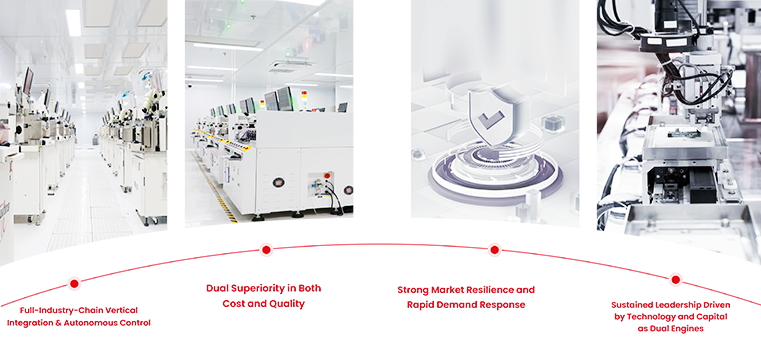
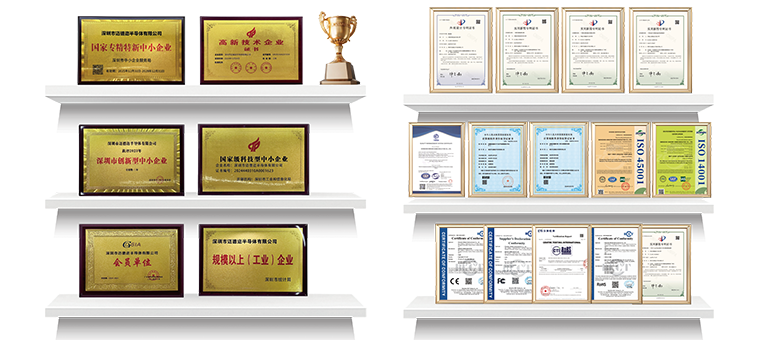
- In-House SMT Assembly: Fully automated Surface-Mount Technology (SMT) production lines ensure precise soldering, consistent assembly, and low defect rates.
- Factory Quality Testing: Automated optical inspection (AOI) combined with high-temperature burn-in testing according to product and project requirements.
- Flexible OEM/ODM Customization: OEM branding, custom drive labeling, customized model strings, and tailored packaging options for PC builders and regional brands.
- Technical & RMA Support: Dedicated technical support to assist buyers with platform compatibility validation, testing queries, and warranty service.
8. Final Checklist Before Placing a Bulk Purchase Order
Before issuing a formal purchase order, review this final checklist with your supplier:
- Form Factor & Dimensions: 2.5-inch, 7mm thickness confirmed for target enclosures.
- Interface Compatibility: SATA III 6Gb/s interface confirmed.
- Capacity & Configuration: Required capacity (128GB to 2TB) and qualified 3D TLC configuration confirmed.
- Controller & Firmware: Approved controller configuration and firmware version agreed upon.
- Performance Profile: Target read/write performance (e.g., 550 MB/s Read / 500 MB/s Write) and IOPS aligned with project requirements.
- Endurance (TBW): Rated endurance aligned with expected workload lifespan.
- Sample Validation: Target platform compatibility and OS deployment verified on actual hardware.
- Batch Control & Traceability: Process established for managing hardware revisions and serial number tracking.
- Order & Warranty Terms: MOQ, sample lead time, production lead time, and 3-year warranty terms defined.
For additional advice tailored specifically to system assembly projects, read:
👉 How to Choose an SSD Supplier for PC Builders: Bulk Procurement Guide
FAQ
What should I test before placing a bulk 2.5-inch SATA SSD order?
Buyers should perform basic benchmark testing, including capacity, sequential and random read/write speeds, and S.M.A.R.T. health checks. Platform validation should also cover OS deployment, cold boots, reboots, sleep/wake cycles, and continuous data transfers on representative host hardware.
How important is BOM consistency for repeat SSD orders?
BOM (Bill of Materials) consistency is critical for recurring bulk procurement. Unannounced changes to the controller, NAND flash, or firmware can alter write performance, power behavior, or platform compatibility, leading to system integration issues or higher return rates across production batches.
Why do write speeds decrease during large file transfers on some 2.5-inch SATA SSDs?
This occurs when the SSD's SLC cache buffer becomes full during continuous write operations, causing write speeds to adjust to the direct write performance of the NAND flash. Testing sustained write behavior helps buyers understand how the drive will perform under heavy data workloads.
How can buyers prevent unexpected component changes in bulk SSD orders?
Buyers should approve a detailed specification sheet during sample testing and establish a clear agreement with the supplier regarding component control. Suppliers should communicate before modifying key components, such as the controller or NAND flash.
Are custom OEM labels and packaging options available for bulk orders?
Yes. Taimi provides flexible OEM customization services, including custom branding on drive labels, customized model strings in drive firmware, and specialized bulk ESD or retail packaging designed for system integration and distribution.
Partner with Taimi for Bulk 2.5-Inch SATA SSD Projects
Taimi specializes in the design, testing, and volume manufacturing of consumer-grade SSD and storage products for system builders, distributors, and OEM customers.
Whether you need standard 2.5-inch SATA III SSDs for desktop and laptop assembly or customized storage configurations for regional distribution, our team offers sample testing support, consistent production quality, and reliable warranty backing.
Ready to Evaluate 2.5-Inch SATA SSD Samples for Your Project?
Contact our technical sales team to discuss your project requirements, request detailed product specifications, or order evaluation units for platform testing.
Related Products
Recommended Articles
What Is SLC Cache in an SSD? How It Affects Write Speed and Sustained Performance (2026 Guide)
2026-09-27
More
How to Choose a PCIe 3.0 SSD Supplier for Bulk Orders
2026-09-23
More
UFS vs eMMC: Speed, Performance, Versions, and Key Differences
2026-09-21
More
How to Choose an SSD Supplier for PC Builders: Bulk Procurement Guide
2026-09-11
More
What Is NAND Flash? Types, Speed, Endurance, and Applications Explained
2026-09-10
More
What Is UFS Storage? Speed, Versions, and OEM Selection Guide
2026-09-14
More
What Is an M.2 SSD? Form Factors, Keys & NVMe vs SATA Explained (2026 Guide)
2026-09-18
More
What Is eMMC? Everything You Need to Know About eMMC Storage
2026-09-04
More
What Is a SATA SSD? Speed, Benefits, Compatibility, and Applications (2026 Guide)
2026-08-14
More
What Is an NVMe SSD? Complete Guide to Speed, Gaming Performance, Compatibility, and SSD Selection (2026)
2026-08-12
More