
Company Introduction
More












What Is eMMC? Everything You Need to Know About eMMC Storage
Share:
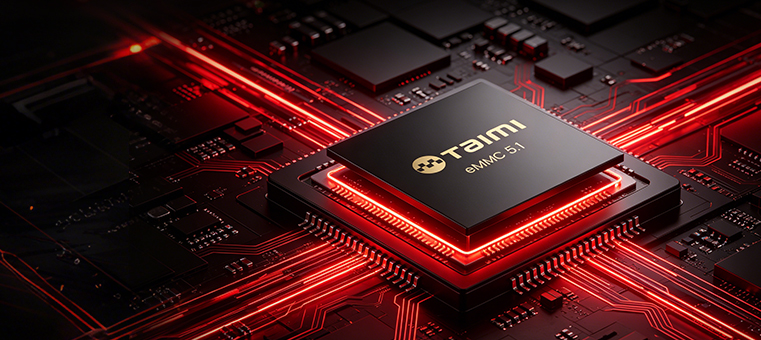
eMMC stands for embedded MultiMediaCard. It is a type of embedded flash storage that combines NAND flash memory and a storage controller into a single package. eMMC storage is widely used in tablets, smart home devices, IoT products, industrial control systems, automotive multimedia terminals, and other embedded applications where compact size, low power consumption, and cost efficiency are important.
In this guide, we explain what eMMC is, how eMMC storage works, what eMMC 5.1 means, how fast eMMC can be, and how eMMC compares with SATA SSD and NVMe SSD. We also look at practical eMMC specifications and selection considerations for OEM and embedded applications.
Quick Answer: What Is eMMC?
eMMC is an embedded flash storage solution that integrates NAND flash memory and a storage controller into one package. Unlike a traditional SSD, which is usually installed as a separate storage device, eMMC is designed to be directly integrated onto the host device's PCB. This makes it suitable for compact and cost-sensitive embedded products.
What Does eMMC Stand For?
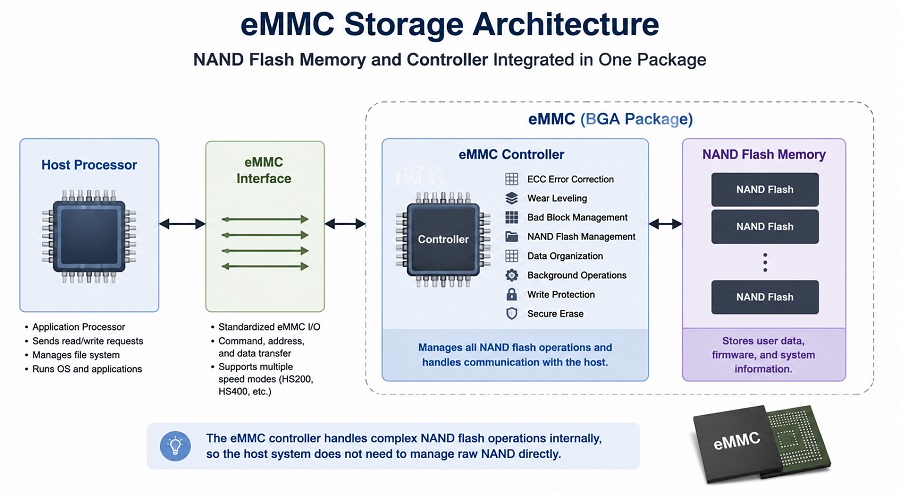
eMMC stands for embedded MultiMediaCard. Despite the name, modern eMMC is more than a removable memory card. It is an embedded storage device that combines NAND flash memory, a controller, firmware, and a standardized interface inside a single BGA package.
The host processor communicates with the eMMC through the eMMC interface, while the internal controller manages NAND flash operations such as error correction, wear leveling, bad block management, and data organization.
Because these functions are handled internally, the host system does not need to manage raw NAND flash directly.
How Does eMMC Storage Work?
An eMMC device typically contains two major storage-related components:
- NAND Flash: Stores user data.
- eMMC Controller: Manages communication with the host system and controls NAND flash operations.
A simplified eMMC architecture looks like this:
Host Processor → eMMC Interface → eMMC Controller → NAND Flash
When the host device writes data, the eMMC controller receives the data and determines where it should be stored in NAND flash. It also handles error correction, wear leveling, bad block management, and other flash-management operations.
This integrated design simplifies system development and makes eMMC particularly useful for embedded devices with limited PCB space.
What Are the Main Components of eMMC?
1. NAND Flash Memory
NAND flash is the non-volatile memory inside an eMMC device. It stores the operating system, applications, user files, and other data even when the device is powered off.
Depending on the product configuration, eMMC can use different NAND types, including MLC, TLC, and QLC.
2. eMMC Controller
The controller is responsible for managing communication between the host processor and NAND flash.
Typical controller functions include:
- ECC error correction
- Wear leveling
- Bad block management
- NAND flash management
- Data organization
- Background operations
- Write protection
- Secure erase
For embedded storage, controller firmware and NAND configuration are important because they directly affect performance, endurance, and long-term stability.
3. eMMC Interface
The eMMC interface provides communication between the host processor and the storage device. Because the controller is integrated into the eMMC package, system designers do not need to implement a separate SSD controller on the main board.
What Is eMMC 5.1?
eMMC 5.1 is a specification version for embedded MultiMediaCard devices. It provides improvements in performance and functionality compared with earlier eMMC generations and is widely used in modern embedded storage applications.
eMMC 5.1 supports higher-performance operating modes, including HS400, allowing compatible devices to achieve significantly higher sequential transfer rates than older eMMC implementations.
However, the actual performance of an eMMC device depends on several factors, including:
- NAND flash type
- Controller design
- Firmware
- Host platform
- Interface configuration
- Capacity
- Workload characteristics
Therefore, the eMMC 5.1 specification alone does not determine the actual performance of every product.
How Fast Is eMMC?
eMMC performance is generally lower than modern NVMe SSD performance, but that does not mean eMMC is unsuitable for embedded applications.
For many embedded devices, eMMC provides a practical balance between storage capacity, power consumption, PCB space, performance, and cost.
For example, Taimi's eMMC 5.1 products offer different performance levels depending on NAND configuration.
| Specification | TEMXXC008 | TEMXXC032 |
|---|---|---|
| eMMC Standard | eMMC 5.1 | eMMC 5.1 |
| NAND Type | MLC | TLC / QLC |
| Capacity | 4GB / 8GB / 16GB / 32GB | 32GB / 64GB / 128GB / 256GB |
| Package | BGA153 | BGA153 |
| Dimensions | 11.5 × 13 × 1.0 mm | 11.5 × 13 × 1.0 mm |
| Sequential Read | Up to 230 MB/s | Up to 320 MB/s |
| Sequential Write | Up to 210 MB/s | Up to 200 MB/s |
| Random Read | Up to 3.6K IOPS | Up to 3.5K IOPS |
| Random Write | Up to 1.8K IOPS | Up to 4K IOPS |
| Operating Temperature | -20°C to 80°C | -20°C to 80°C |
| Data Retention | >10 years | >10 years |
| Endurance | MLC: 5K P/E cycles | TLC: 3K P/E cycles |
| Interface Mode | HS400 | HS400 |
These specifications illustrate an important point: eMMC performance is not determined by the interface standard alone. NAND type, controller configuration, firmware, and product design all influence the final performance.
MLC, TLC, and QLC eMMC: What Is the Difference?
The NAND type used in eMMC affects capacity, endurance, cost, and performance characteristics.
| NAND Type | General Characteristics | Typical Consideration |
|---|---|---|
| MLC | Higher endurance and lower bits per cell | Applications requiring higher endurance |
| TLC | Balanced capacity, cost, and endurance | General embedded applications |
| QLC | Higher storage density and lower cost per GB | Capacity-focused applications |
For OEM applications, NAND selection should be based on the actual workload rather than capacity or price alone. Write frequency, expected product lifetime, temperature conditions, and required endurance should all be considered.
What Is eMMC Used For?
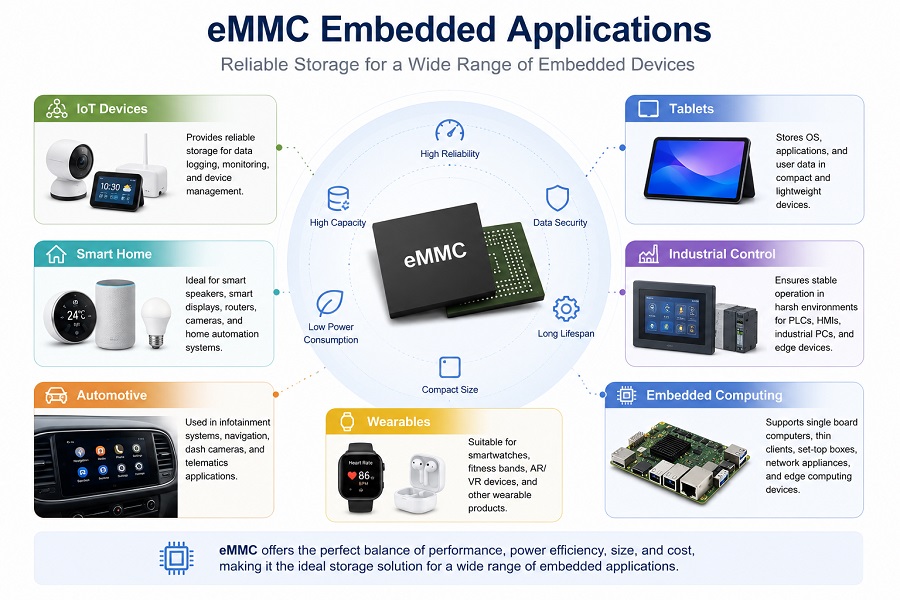
eMMC is designed for embedded products where storage needs to be integrated directly into the device.
Common eMMC applications include:
- IoT devices
- Tablets
- Smart home products
- Industrial control modules
- Automotive multimedia terminals
- Wearable devices
- Embedded computing systems
- Consumer electronics
Its compact BGA package makes eMMC particularly useful when PCB space is limited. The integrated controller also reduces the complexity of implementing storage on the host board.
eMMC vs SSD: Is eMMC a Type of SSD?
eMMC and SSDs both use NAND flash memory, but they are designed differently.
eMMC is an embedded storage device that integrates NAND flash and its controller into a single package. An SSD is normally a separate storage device with its own controller, NAND packages, PCB, firmware, and interface.
| Feature | eMMC | SSD |
|---|---|---|
| Form | Embedded BGA package | Separate storage device |
| Controller | Integrated | Integrated into SSD |
| Typical Interface | eMMC interface | SATA or PCIe/NVMe |
| Replaceability | Usually soldered to the PCB | Usually replaceable |
| Typical Use | Embedded devices | PCs, laptops, workstations, and other systems |
So, while eMMC and SSDs share NAND flash technology, eMMC should not simply be considered a smaller SSD. They target different system architectures and use cases.
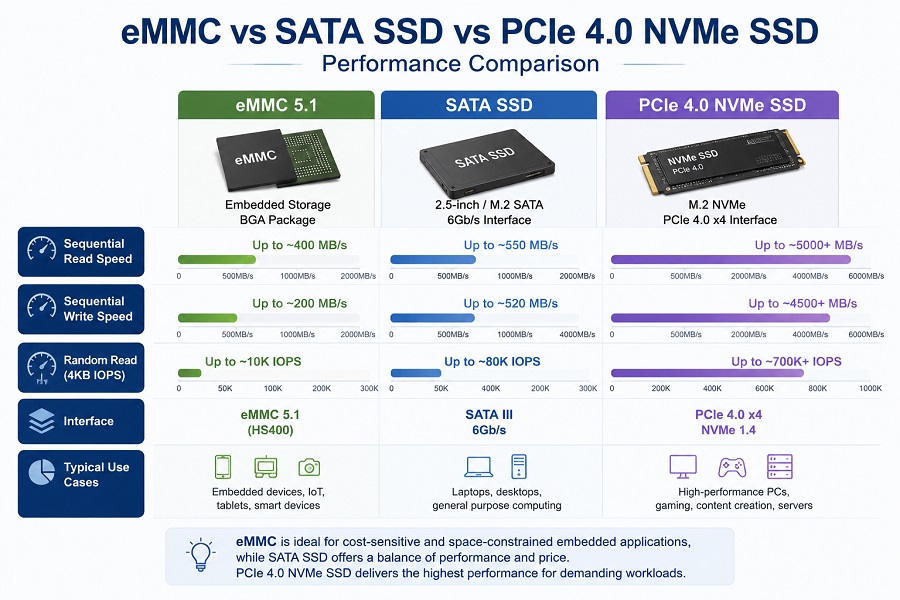
eMMC vs NVMe SSD
NVMe SSDs are designed for high-performance storage over the PCIe interface. They can provide significantly higher sequential and random performance than eMMC.
For example, PCIe 4.0 NVMe SSDs can reach several GB/s of sequential throughput, while eMMC performance is generally measured in hundreds of MB/s.
However, maximum speed is not always the most important factor for an embedded device.
eMMC can be a better fit when a product prioritizes:
- Compact PCB design
- Low system complexity
- Lower storage cost
- Low power consumption
- Integrated storage
- Predictable embedded deployment
eMMC vs SATA SSD
SATA SSDs generally offer higher storage performance than eMMC and are commonly used in PCs, laptops, industrial computers, and other systems with SATA interfaces.
However, SATA SSDs are normally implemented as separate storage devices, while eMMC is soldered directly onto the host PCB.
For embedded applications where space and integration are more important than upgradeability, eMMC can provide a simpler hardware architecture.
Advantages and Limitations of eMMC Storage
Advantages of eMMC
- Compact design: NAND and controller are integrated into a small package.
- Simple system integration: The host system does not need to manage raw NAND directly.
- Cost efficiency: eMMC can be a practical option for cost-sensitive embedded products.
- Low PCB footprint: The BGA package helps save board space.
- Integrated flash management: Functions such as ECC and wear leveling are handled internally.
Limitations of eMMC
- Performance is generally lower than modern NVMe SSDs.
- Storage is normally soldered to the host PCB.
- Capacity options are more limited than many consumer SSD products.
- Replacing failed storage can be more difficult because the device is embedded.
How to Choose eMMC Storage
When selecting eMMC for an embedded product or OEM project, capacity should not be the only consideration.
1. Choose the Right Capacity
Determine the required operating system space, application storage, user data, and future storage requirements before selecting the capacity.
2. Check NAND Type
MLC, TLC, and QLC have different characteristics. The appropriate NAND type depends on workload, endurance requirements, capacity, and cost targets.
3. Evaluate Performance
Check sequential read/write and random IOPS rather than relying only on the eMMC generation number.
4. Consider Endurance
For devices with frequent write operations, endurance should be evaluated carefully. Look at the specified P/E cycles and consider the actual workload of the final product.
5. Check Temperature Requirements
Operating temperature can affect storage reliability. Make sure the selected eMMC matches the temperature conditions of the final device.
6. Verify Host Compatibility
Before mass production, verify the eMMC interface, voltage requirements, package, firmware behavior, and compatibility with the target processor and PCB design.
7. Evaluate Supply Consistency
For OEM production, stable supply and batch consistency can be just as important as the initial sample performance. NAND, controller, firmware, and production configuration should remain controlled across production batches.
Taimi eMMC 5.1 Storage Solutions
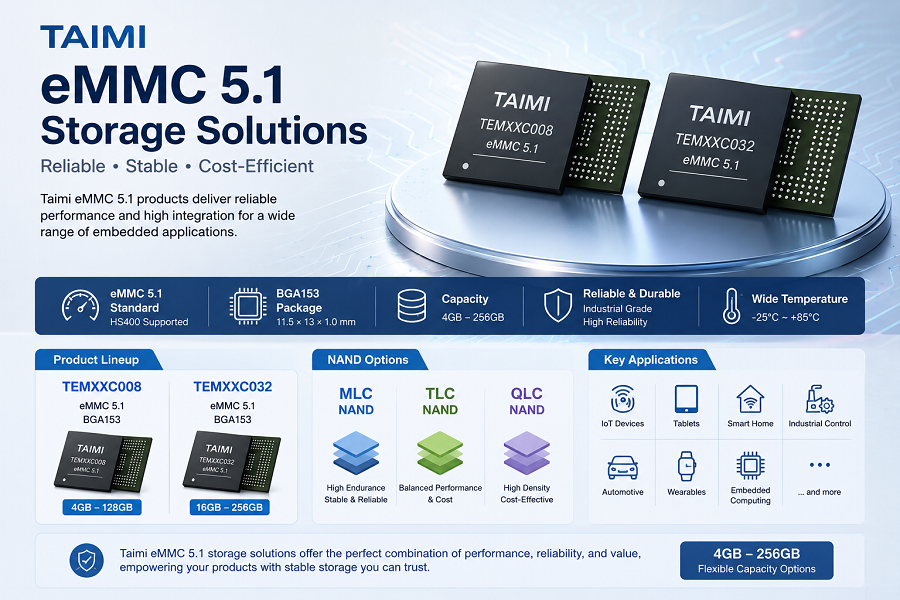
Taimi provides eMMC 5.1 storage solutions for embedded and consumer applications, with product configurations covering different capacities and NAND types.
The TEMXXC008 series uses MLC NAND and is available from 4GB to 32GB. It supports HS400 and provides sequential read/write performance of up to 230/210 MB/s.
The TEMXXC032 series is available in TLC configurations from 32GB to 128GB and a 256GB QLC configuration. It supports HS400 and provides sequential read/write performance of up to 320/200 MB/s.
| Feature | Taimi TEMXXC008 | Taimi TEMXXC032 |
|---|---|---|
| NAND | MLC | TLC / QLC |
| Capacity | 4GB–32GB | 32GB–256GB |
| Package | BGA153 | BGA153 |
| Size | 11.5 × 13 × 1.0 mm | 11.5 × 13 × 1.0 mm |
| Sequential Read/Write | Up to 230/210 MB/s | Up to 320/200 MB/s |
| Temperature | -20°C to 80°C | -20°C to 80°C |
| Data Retention | >10 years | >10 years |
| Endurance | MLC: 5K P/E cycles | TLC: 3K P/E cycles |
| Key Features | LDPC ECC, wear leveling, write protection, hardware reset, background operations, secure erase | LDPC ECC, wear leveling, write protection, hardware reset, background operations, secure erase |
Taimi also supports customized validation testing and software/hardware customization for suitable OEM projects. Product testing can include conditions such as shock, vibration, pressure variation, electromagnetic interference, temperature differences, and mechanical stress.
For applications requiring stable embedded storage across production batches, compatibility validation and production consistency should be evaluated before mass deployment.
Frequently Asked Questions About eMMC
What is eMMC?
eMMC stands for embedded MultiMediaCard. It is an embedded flash storage solution that integrates NAND flash memory and a storage controller into a single package.
Is eMMC a type of SSD?
eMMC and SSDs both use NAND flash memory, but they are different storage architectures. eMMC integrates storage and controller functions into a compact BGA package for embedded applications, while SSDs are normally separate storage devices using interfaces such as SATA or PCIe/NVMe.
Is eMMC faster than SATA SSD?
In general, SATA SSDs provide higher storage performance than eMMC. However, eMMC can be a better choice when compact size, integration, power efficiency, and cost are more important than maximum storage speed.
Is eMMC faster than NVMe?
No. NVMe SSDs use PCIe and can provide significantly higher sequential and random performance than eMMC. eMMC is designed primarily for integrated embedded storage rather than maximum performance.
What is eMMC 5.1?
eMMC 5.1 is a specification version for embedded MultiMediaCard storage. Compatible devices can support high-performance modes such as HS400, although actual performance depends on the NAND, controller, firmware, host platform, and product configuration.
What is eMMC used for?
eMMC is commonly used in tablets, IoT devices, smart home products, industrial control modules, automotive multimedia terminals, wearables, and other embedded consumer electronics.
What is the difference between MLC, TLC, and QLC eMMC?
MLC, TLC, and QLC store different numbers of bits per NAND cell and therefore have different characteristics in terms of endurance, density, capacity, and cost. The appropriate NAND type depends on the workload and product requirements.
How do I choose eMMC storage for an OEM product?
Consider capacity, NAND type, sequential and random performance, endurance, operating temperature, host compatibility, package requirements, validation testing, batch consistency, and long-term supply availability.
Conclusion: Is eMMC Still a Good Storage Solution?
eMMC remains a practical storage solution for many embedded and consumer electronics applications. Its main advantages are its compact package, integrated controller, simple system integration, and cost-efficient design.
It is not intended to replace high-performance NVMe SSDs in every application. Instead, eMMC is most useful when the product requires integrated storage and a balanced combination of performance, power consumption, PCB space, reliability, and cost.
For OEM and embedded applications, the right eMMC should be selected based on the actual workload and system requirements rather than interface version or capacity alone.
Looking for an eMMC Storage Solution?
Taimi provides eMMC 5.1 storage solutions for embedded and consumer applications, with different NAND configurations, capacities, and validation options.
Request a QuoteRelated Products
Recommended Articles
How to Evaluate an SSD Supplier: A Checklist for Bulk Buyers
2026-09-02
More
M.2 SSD Compatibility Guide 2026: How to Check NVMe Support Before Buying
2026-08-28
More
How to Check If Your Laptop Supports an SSD Upgrade: SSD Compatibility Guide (2026)
2026-08-26
More
How Much SSD Storage Do You Need? 512GB vs. 1TB vs. 2TB SSD
2026-08-24
More
What Is a PCIe SSD? Speed, NVMe, and Compatibility Guide (2026)
2026-08-19
More
What Is an NVMe SSD? Complete Guide to Speed, Gaming Performance, Compatibility, and SSD Selection (2026)
2026-08-12
More
What Is a SATA SSD? Speed, Benefits, Compatibility, and Applications (2026 Guide)
2026-08-14
More