
Company Introduction
More














How to Evaluate an SSD Supplier: A Checklist for Bulk Buyers
Share:
Buying SSDs in bulk is fundamentally different from purchasing a few retail drives for personal computers.
For system integrators, PC builders, regional distributors, and OEM partners, evaluating an SSD supplier goes far beyond comparing the unit price of a 512GB or 1TB drive. While a lower unit price looks attractive initially, the total cost of purchasing is determined by product consistency, component quality, testing standards, supply stability, warranty support, and delivery capability.
A single flawless evaluation sample is not enough. What truly matters for bulk purchasing is batch consistency—the supplier’s ability to deliver identical quality, hardware configurations, and performance across repeat orders.
This SSD supplier evaluation checklist outlines key areas procurement teams should verify before placing large orders to manage supply chain risks and ensure predictable deployment.
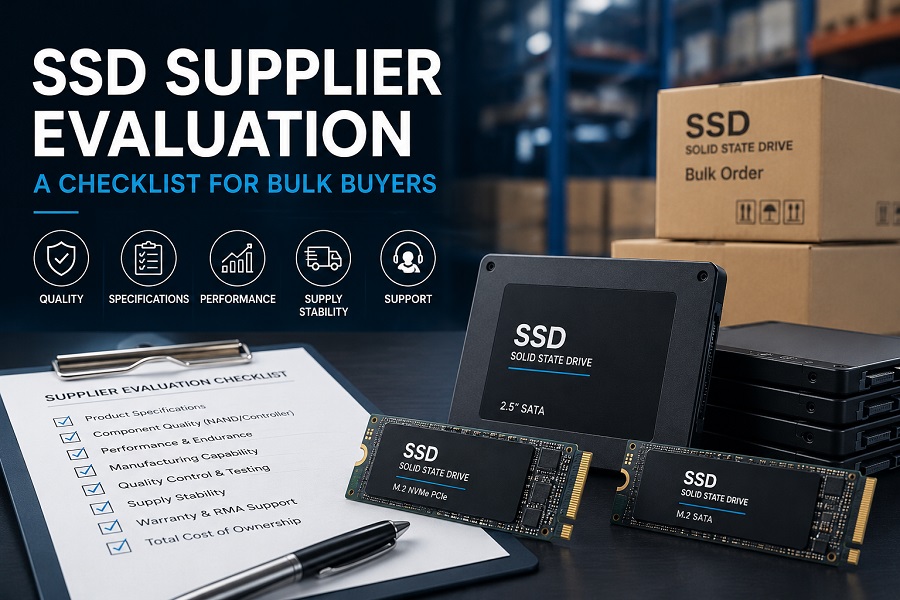
1. Verify Complete Specifications (Beyond the Spec Sheet)
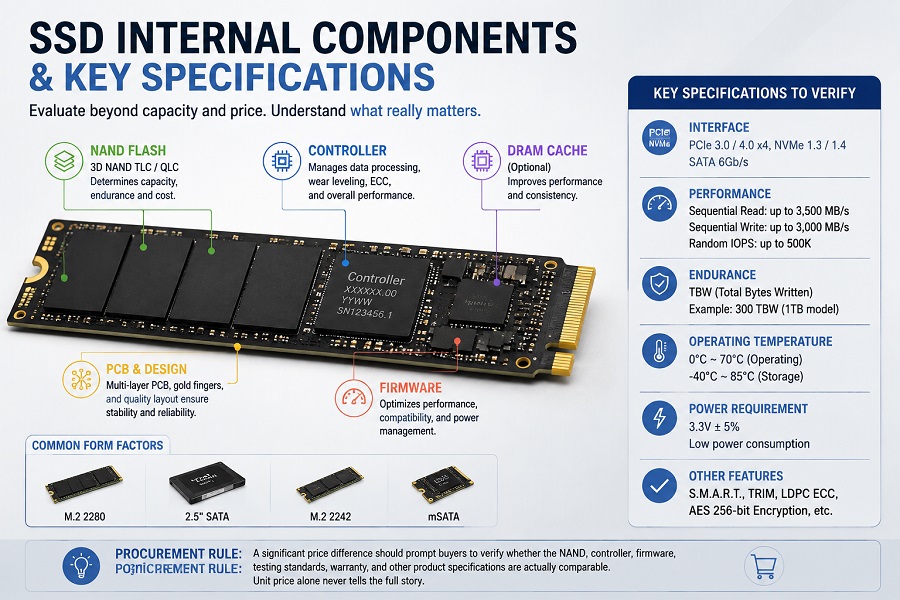
Two SSDs with identical capacities and form factors can perform drastically differently in real-world deployments if their internal configurations differ. Before comparing quotations, request a complete product specification sheet from the supplier that explicitly defines the hardware architecture.
For a broader overview of how to evaluate SSDs for different computers and applications, see our SSD Buying Guide.
Key parameters your procurement team should verify include:
- Form Factor & Interface: M.2 2280, 2.5-inch SATA, PCIe 3.0/4.0 x4, NVMe protocol.
- Component Architecture: NAND Flash type (TLC vs. QLC), Controller model, and DRAM or DRAM-less configuration.
- Performance & Endurance: Rated sequential read/write speeds, sustained write behavior, and TBW (Total Bytes Written) rating.
- Operating Conditions: Rated operating temperature ranges, voltage tolerance, and thermal throttling behavior.
Procurement Rule: A significant price difference should prompt buyers to verify whether the NAND, controller, firmware, testing standards, warranty, and other product specifications are actually comparable. Unit price alone never tells the full story.
2. NAND Flash Sourcing & BOM Management
NAND Flash is typically one of the largest cost components in an SSD and has a major influence on capacity, endurance, and overall product cost. When evaluating an SSD supplier for bulk orders, procurement teams must understand how NAND components are sourced and managed.
For a detailed look at how storage drives move from components through assembly and testing, see our guide to the SSD manufacturing and testing process.
Critical questions to ask:
- What type and source of NAND Flash are used in the product model?
- How does the supplier verify NAND quality, authenticity, and endurance ratings?
- Is the Bill of Materials (BOM) documented and controlled for this specific product model?
- What is the supplier's formal process for validating and notifying customers about necessary component substitutions?
If a supplier changes NAND components between production batches without notification, the SSD may exhibit unpredictable differences in sustained performance, power consumption, or endurance.
3. Controller Stability & Firmware Consistency
The controller manages essential SSD operations, including wear-leveling algorithms, garbage collection, thermal management, and error correction (ECC).
For more information about the role of the controller in SSD performance, thermal behavior, and lifespan, see our detailed guide to SSD controllers.
While controller capabilities dictate peak performance, firmware consistency is what helps prevent field issues. Ask the supplier:
“If we reorder this exact SSD model several months later, will the controller model, PCB design, and firmware configuration remain consistent?”
A reliable bulk SSD supplier maintains strict revision control. If component modifications or firmware updates become necessary, the supplier should follow a clear validation procedure and provide advance documentation before mass production.
4. Evaluate Manufacturing Control & SMT Capability
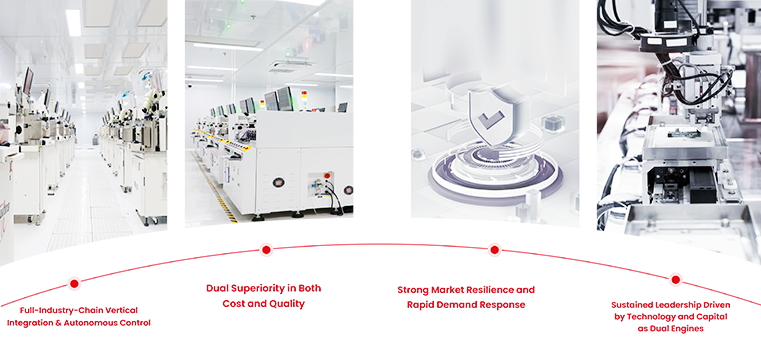
Understand what type of supplier you are partnering with. Is the vendor a direct SSD manufacturer operating SMT (Surface Mount Technology) assembly lines, an OEM/ODM partner, a distributor, or a trading reseller?
While different supplier types offer distinct commercial advantages, working with an OEM SSD supplier or direct manufacturer that maintains direct oversight of manufacturing can provide greater visibility into quality control, production traceability, and technical accountability. Evaluate:
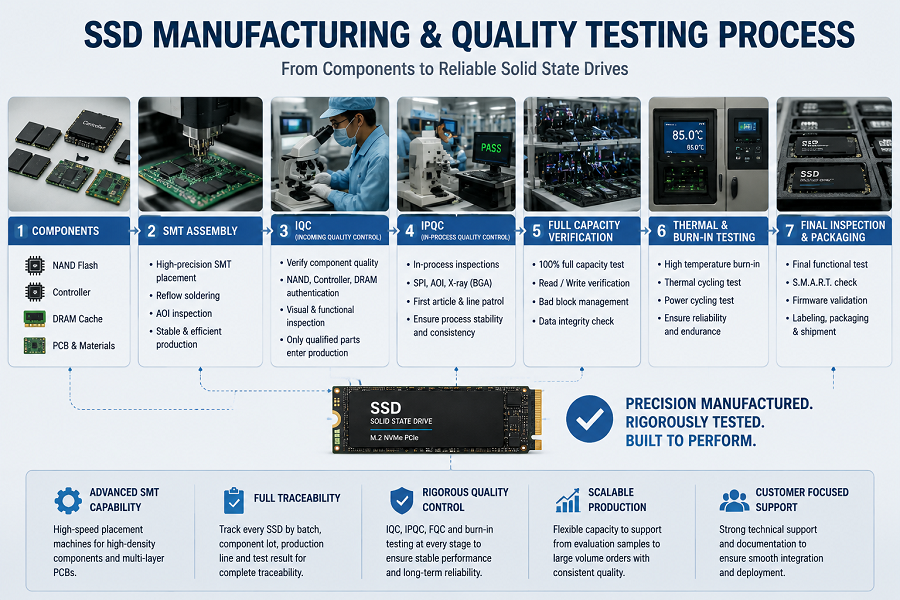
- SMT Production Capability: Modern placement lines capable of precision assembly for high-density components and multi-layer PCBs.
- Production Traceability: Systems that track finished drives back to specific production batches, assembly lines, and component lots.
- Scalability: The capacity to transition smoothly from initial evaluation samples to high-volume production schedules without quality degradation.
5. Quality Control & Testing Procedures
A visual inspection prior to shipment is insufficient for bulk purchasing. Quality control procedures should span multiple stages of the manufacturing workflow:
- Incoming Component Inspection (IQC): Verifying NAND Flash, controller ICs, PMICs, and raw PCBs before assembly.
- In-Process Quality Control (IPQC): Monitoring SMT assembly, soldering, and component placement to minimize manufacturing defects.
- Full-Capacity Verification & Read/Write Testing: Validating functional capacity and data integrity across drive sectors rather than relying solely on quick sampling.
- Thermal & Burn-In Testing: Operating drives under controlled temperature and workload conditions to identify early-life failures and verify stability before shipment.
6. Sample Evaluation Before Bulk Ordering
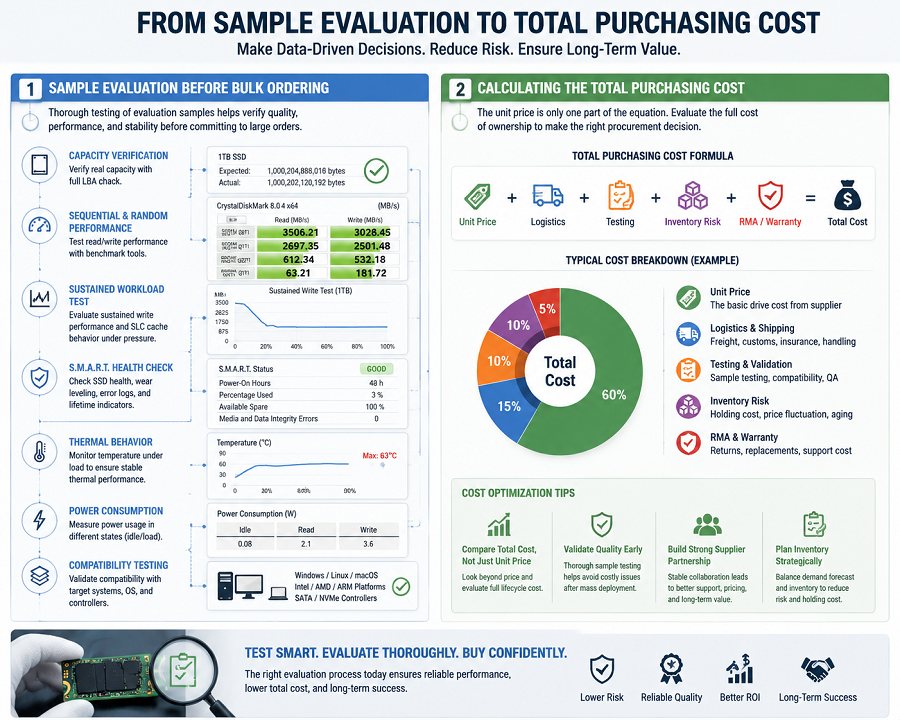
Never approve a large SSD procurement order based only on a datasheet. Request evaluation samples and test them under actual deployment conditions whenever possible.
When testing SSD samples, bulk buyers should verify:
- Capacity Verification: Confirm reported drive capacity, sector alignment, and partition behavior under host operating systems.
- Sequential & Random Performance: Measure peak read/write throughput and IOPS using benchmark suites such as CrystalDiskMark and IOMeter.
- Sustained Workload Behavior: Test continuous write operations to evaluate SLC cache sizes and off-cache write stability.
- S.M.A.R.T. Data & Health Monitoring: Inspect reported S.M.A.R.T. attributes, temperature sensors, and health indicators.
- Thermal Behavior: Monitor operating temperatures under sustained workloads to evaluate thermal dissipation and throttling thresholds.
- Power Behavior: Verify drive behavior during cold boots, warm reboots, sleep states, and sudden power-loss events.
For more information about manufacturer-level SSD reliability testing, see our guide to SSD burn-in testing.
Practical Tip: A sample should be treated as a validation step, not as proof that every future production batch will be identical. For bulk purchasing, buyers should also verify the supplier's BOM control, revision management, and batch traceability.
7. Compatibility Validation
Lab benchmarks on a single reference system do not guarantee stability across diverse target environments. For PC builders and system integrators deploying drives across various systems, compatibility must be validated thoroughly.
For a deeper explanation of M.2 form factors, interfaces, keys, and platform compatibility, see our M.2 SSD Compatibility Guide.
Ask the supplier to confirm:
- Host Platform Testing: Compatibility across major CPU platforms such as Intel and AMD and different motherboard ecosystems.
- Operating System Support: Stable booting and power-state recovery across Windows, Linux distributions, and embedded operating systems.
- Hardware Integration: Form factor fit, connector tolerance, and thermal pad alignment across desktop chassis, laptops, and mini PCs.
8. Review Warranty Terms & RMA Procedures
Warranty length is important, but the responsiveness and transparency of the actual RMA (Return Merchandise Authorization) process matter just as much during field deployments. Clarify key logistics before placing an order:
- What are the specific terms and turnaround times for DOA (Dead on Arrival) units?
- How are shipping responsibilities allocated for defective units?
- What diagnostic information or failure logs are required to process an RMA claim?
- Does the supplier provide technical support contacts for troubleshooting deployment issues?
9. Calculating the Total Purchasing Cost
Relying solely on the lowest unit price can lead to higher overall costs over the product lifecycle. Inconsistent components or unverified drives can result in field failures, higher RMA rates, customer support expenses, and production delays.
Total Purchasing Cost = Unit Price + Logistics + Internal Testing Cost + Inventory Risk + Potential RMA / Field Costs
Evaluating an SSD supplier based on a balance of Price + Quality + Batch Consistency + Supply Stability can help reduce total purchasing costs over time.
Summary: SSD Supplier Evaluation Checklist
| Evaluation Domain | Key Questions & Verification Items | What to Avoid |
|---|---|---|
| Specification & BOM | Complete spec sheets; documented controller, NAND, and firmware configuration with clear revision control | Unclear spec sheets or undisclosed component substitutions |
| Component Quality | Verified NAND sourcing and documented component validation | Unverified component sources without traceability |
| Manufacturing | Clear manufacturing oversight and batch-level MES traceability | Zero batch tracking or unvetted production workflows |
| Testing Standards | Full-capacity verification, read/write testing, thermal burn-in | Superficial quick tests or lack of burn-in procedures |
| Sample Evaluation | Verified sustained performance, S.M.A.R.T. health, and thermal behavior | Approving bulk orders based solely on datasheets |
| Compatibility | Validated across target platforms, BIOS versions, and OS environments | Testing limited to a single internal test system |
| Warranty & RMA | Defined DOA terms, clear RMA procedures, and technical support | Unclear replacement policies and slow technical response |
Frequently Asked Questions (FAQ)
Q1: What is the most critical factor when purchasing SSDs in bulk?
While unit price is important, batch consistency is one of the most critical factors for bulk purchasers. Ensuring that the controller, NAND Flash configuration, PCB revision, and firmware remain consistent across multiple production runs can help prevent unexpected performance differences, compatibility issues, and RMA costs.
Q2: Why is testing samples on actual target platforms so important?
Datasheets only represent theoretical performance under ideal lab environments. Testing physical SSD samples under your specific hardware ecosystem (target motherboards, CPUs, OS versions, and thermal conditions) helps verify whether the drive can handle real-world sustained workloads, sleep states, and thermal conditions before placing a bulk order.
Q3: How do component substitutions affect SSD performance in repeat orders?
Unannounced component substitutions—such as switching from TLC to QLC NAND or changing the controller model—can significantly affect sustained write performance, latency, power consumption, and endurance characteristics, even if the advertised sequential speeds remain identical on paper.
Q4: Should I buy SSDs from a direct manufacturer or a trading company?
Working with an OEM SSD manufacturer or direct supplier that manages its own SMT lines can provide greater supply chain transparency, clearer BOM control, batch-level traceability, and more direct technical support for RMA failure analysis compared to pure resellers.
Q5: Can Taimi provide customized OEM/ODM SSD solutions and samples for evaluation?
Yes. Taimi supports PC builders, system integrators, and regional distributors with flexible capacity options, private-label packaging, firmware revision control, and strict BOM management. Evaluation samples are available for performance and compatibility testing prior to placing bulk orders.
How Taimi Supports Bulk SSD Buyers
At Taimi, we provide reliable storage solutions for PC builders, system integrators, distributors, and OEM/ODM customers worldwide.
From component processing and SMT assembly to finished SSD testing, Taimi maintains controlled production and quality validation processes designed to support consistent output across repeat orders. We prioritize clear product specifications, strict BOM control, and reliable delivery to help bulk buyers manage supply chain risks effectively.
Evaluating an SSD Supplier for Your Next Bulk Order?
Contact Taimi to discuss your required capacity, interface, quantity, technical specifications, and evaluation samples before placing a bulk order.
Request a Quote & Evaluation SamplesRelated Products
Recommended Articles
How Long Do SSDs Last? TBW, NAND Wear, and Real-World Lifespan Explained
2026-08-31
More
M.2 SSD Compatibility Guide 2026: How to Check NVMe Support Before Buying
2026-08-28
More
How to Check If Your Laptop Supports an SSD Upgrade: SSD Compatibility Guide (2026)
2026-08-26
More
How Much SSD Storage Do You Need? 512GB vs. 1TB vs. 2TB SSD
2026-08-24
More
M.2 SSD Compatibility: Sizes, Keys, Bus Protocols, and OEM Validation
2026-08-17
More
What Is a PCIe SSD? Speed, NVMe, and Compatibility Guide (2026)
2026-08-19
More
What Is a SATA SSD? Speed, Benefits, Compatibility, and Applications (2026 Guide)
2026-08-14
More
What Is an NVMe SSD? Complete Guide to Speed, Gaming Performance, Compatibility, and SSD Selection (2026)
2026-08-12
More