
Company Introduction
More










From NAND Flash to Finished SSD: Inside the SSD Manufacturing and Testing Process
Share:
An SSD looks simple from the outside — a PCB, NAND Flash components, a controller, and a compact enclosure.
However, the reliability behind an SSD is created through many manufacturing decisions before the product reaches customers.
From selecting NAND Flash components and optimizing firmware to controlling SMT production and performing final validation, every stage can affect SSD performance, compatibility, and long-term stability.
For SSD manufacturers, building a reliable storage device is not only about achieving high benchmark numbers. The real challenge is maintaining consistent quality across large-volume production for different applications.
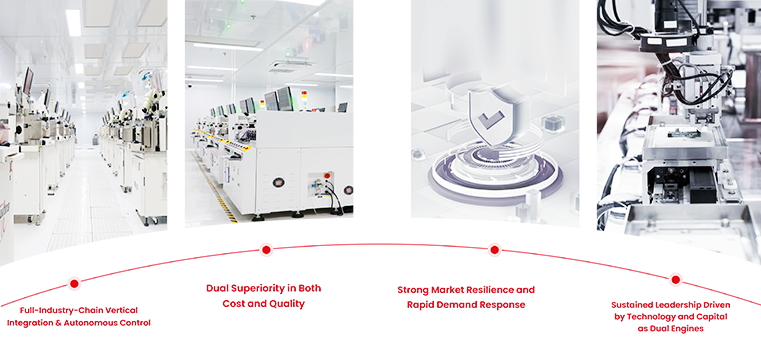
At Taimi (Shenzhen Minder Semiconductor Co., Ltd.), SSD manufacturing covers multiple stages, including component inspection, SMT assembly, firmware programming, performance verification, compatibility testing, and final quality validation.
This integrated approach helps Taimi provide stable SSD solutions for consumer electronics, OEM projects, and industrial applications worldwide.
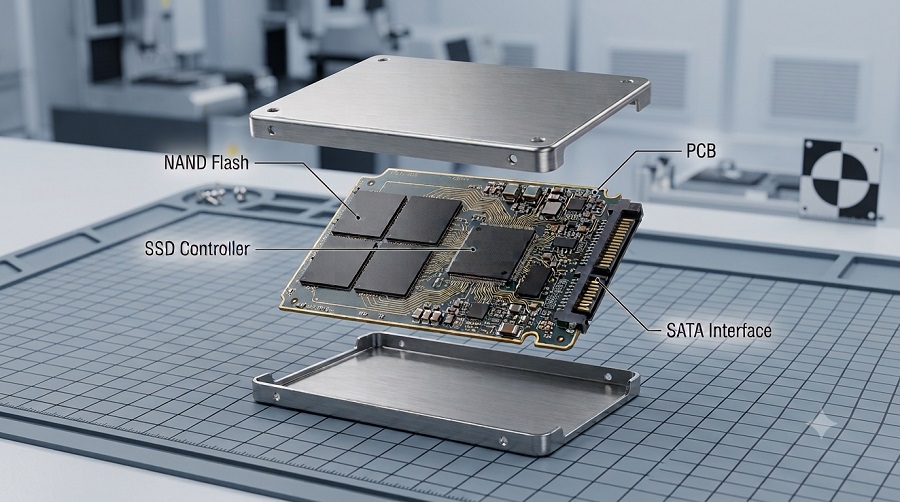
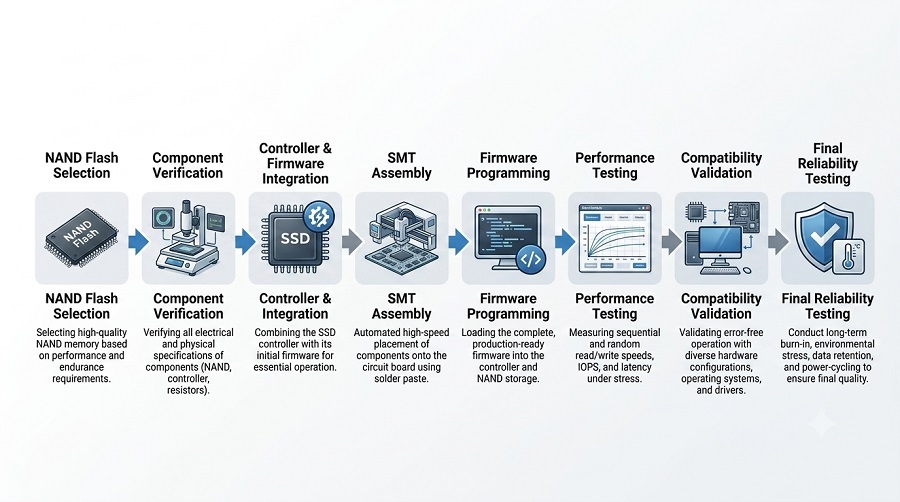
SSD Manufacturing Process Overview
Before an SSD becomes a finished product, it typically goes through the following stages:
NAND Flash Selection
↓
Component Verification
↓
Controller & Firmware Integration
↓
SMT PCB Assembly
↓
Firmware Programming
↓
Performance Testing
↓
Compatibility Validation
↓
Final Reliability Testing
Each stage plays a role in determining SSD quality and customer experience.
NAND Flash Selection: The Foundation of SSD Reliability
NAND Flash is the primary storage medium inside an SSD.
Although two SSDs may have the same capacity, interface, and advertised speed, their actual performance and lifespan can vary because NAND characteristics and NAND architecture (such as TLC and QLC) are different.
During SSD manufacturing, NAND Flash components are evaluated before mass production because even small differences between memory batches can influence performance consistency in large-volume deployments.
Important evaluation factors include:
- NAND quality consistency
- Error characteristics
- Endurance performance
- Data retention capability
- Compatibility with SSD controllers
For OEM customers, NAND consistency is especially important.
When thousands of SSDs are deployed into the same hardware system, differences between memory batches can affect product stability and maintenance costs.
Therefore, professional SSD manufacturing starts with selecting and validating suitable NAND Flash components.
Component Verification Before Production
Before NAND Flash and controllers are assembled onto SSD PCBs, manufacturers perform component verification.
This step helps identify potential risks before they affect large-scale production.
Typical verification includes:
- NAND Flash inspection
- Controller compatibility evaluation
- Electrical performance checking
- Component consistency validation
A problem discovered during incoming inspection is easier and less costly to solve than an issue found after mass deployment.
For OEM projects, this early quality control stage helps improve production consistency and reduces unexpected failures.
Controller and Firmware Optimization: Managing SSD Performance and Stability
The SSD controller manages communication between NAND Flash and the host system.
It handles important functions such as:
- Error Correction Code (ECC)
- Wear leveling
- Garbage collection
- Data management
- Flash management
However, SSD performance is not determined by hardware specifications alone.
Firmware plays an equally important role.
Firmware controls how the SSD manages data, handles background operations, and communicates with different platforms.
A properly optimized firmware system improves:
- Compatibility
- Performance consistency
- Data reliability
- Long-term stability
A reliable SSD requires the right combination of NAND Flash, controller architecture, and firmware optimization.
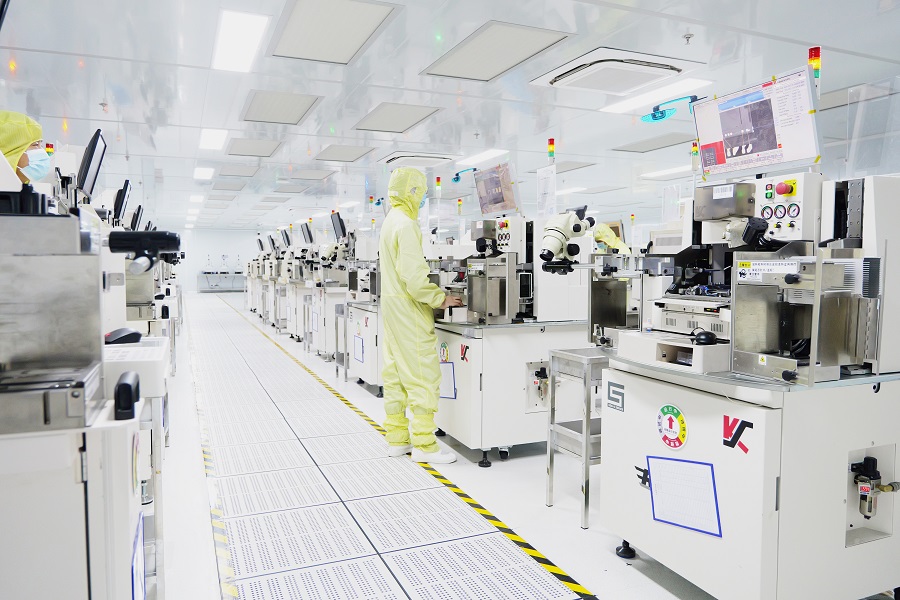
SMT Assembly: Building the SSD Hardware
After component validation, SSD production enters the PCB assembly stage.
Through Surface Mount Technology (SMT), electronic components are accurately mounted onto the SSD PCB.
The manufacturing process includes:
- PCB preparation
- Controller placement
- NAND Flash mounting
- Component soldering
- Production inspection
SMT quality directly affects SSD reliability. Small manufacturing variations, such as soldering issues or component placement errors, may impact product stability during long-term operation. For a closer look at our surface mount line—including 3D SPI, automated optical inspection, and BGA X-Ray testing—read our complete guide on
At Taimi, SSD production integrates SMT assembly, firmware programming, and quality verification processes to maintain consistency across production batches and support OEM customers with stable supply.
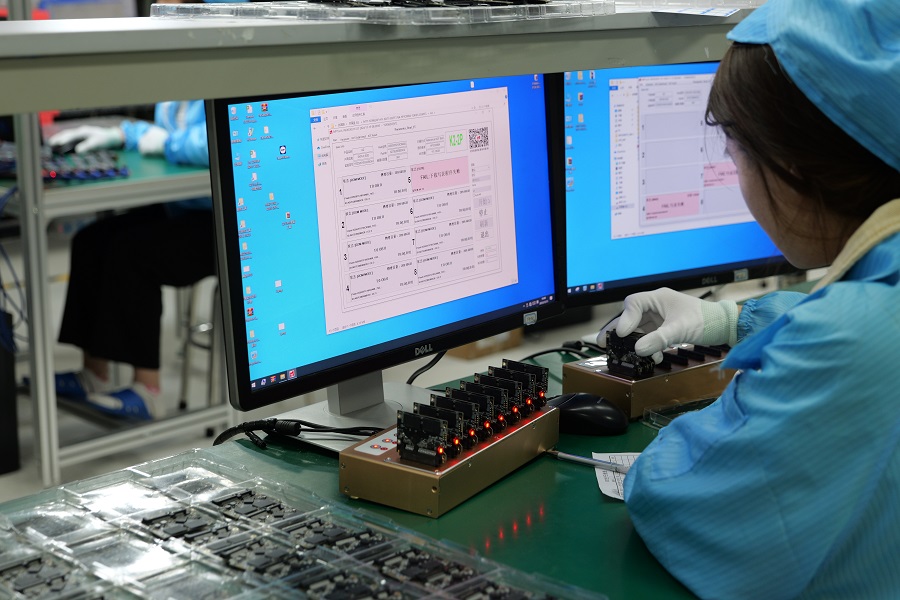
Firmware Programming and SSD Functional Testing
After hardware assembly, SSD products require firmware programming and functional verification.
Engineers verify whether each SSD operates correctly under expected conditions.
Testing includes:
Capacity Verification
Confirm that the SSD reports the correct storage capacity.
Performance Testing
Evaluate:
-
Sequential read/write performance
-
Random access performance
-
Performance stability
A reliable SSD is not only about achieving peak speed. Stable performance during continuous operation is equally important. (To understand how peak speeds, DRAM caching, and controller behavior translate into real-world performance across gaming and professional workloads, see our master guide:
Compatibility Testing Across Different Platforms
An SSD that works well in laboratory testing may still encounter challenges in real applications.
OEM systems often include different:
Motherboards
BIOS versions
Operating systems
Hardware configurations
Therefore, compatibility testing is an essential step before large-scale deployment.
Manufacturers need to confirm that SSD products can operate reliably across the customer's target environment.
During real-world deployment, SSD recognition issues may still occur due to differences between hardware platforms and operating system environments. Learn more about why an SSD is detected in BIOS but not available in Windows.
Reliability Testing Before Shipment
Before delivery, SSD products undergo final reliability validation.
Testing may include:
- Long-term operation testing
- Power stability testing
- Temperature environment testing
- Data integrity verification
The purpose is to ensure that SSDs can maintain stable performance under real-world usage conditions.
For customers purchasing large quantities, reliable testing processes help reduce deployment risks and improve product consistency.
SSD Manufacturing Process and Quality Control Steps
| Manufacturing Stage | Purpose | Key Quality Control |
|---|---|---|
| NAND Flash Selection | Choose suitable memory components | Consistency, endurance, compatibility |
| Component Verification | Identify risks before assembly | Electrical performance, controller matching |
| Controller & Firmware Integration | Optimize SSD operation | Stability, compatibility, data management |
| SMT Assembly | Build SSD hardware | PCB quality, soldering accuracy |
| Firmware Programming | Configure SSD behavior | Performance tuning, system support |
| Functional Testing | Verify basic operation | Capacity, read/write performance |
| Compatibility Testing | Validate different platforms | BIOS, motherboard, OS support |
| Reliability Testing | Confirm long-term stability | Power, temperature, data integrity |
Why OEM Customers Need an Experienced SSD Manufacturing Partner
For individual users, an SSD is a storage upgrade.
For OEM customers, SSD quality affects the entire product lifecycle.
When selecting an SSD supplier, customers should evaluate more than capacity and speed.
Important factors include:
| Evaluation Factor | Why It Matters |
|---|---|
| Manufacturing Capability | Ensures stable production and consistent quality |
| Testing Process | Reduces risks before shipment |
| Firmware Support | Improves compatibility with different systems |
| Customization Ability | Supports specific application requirements |
| Supply Stability | Helps maintain long-term product availability |
An experienced SSD manufacturer can provide better control over product quality, faster technical communication, and more reliable supply.
About Taimi SSD Manufacturing
Taimi (Shenzhen Minder Semiconductor Co., Ltd.) is an SSD manufacturer specializing in SSD design, manufacturing, testing, and OEM storage solutions.
With experience in SSD production and OEM storage solutions, Taimi provides stable supply, customization support, and application-specific storage products for global customers.
Through integrated production processes and engineering validation, Taimi helps customers develop reliable SSD solutions for different applications.
From component selection to final shipment, Taimi works to maintain stable SSD quality through controlled manufacturing and testing processes.
Frequently Asked Questions
How are SSDs manufactured?
SSD manufacturing includes NAND Flash selection, component verification, controller and firmware integration, SMT assembly, functional testing, compatibility validation, and final reliability testing.
Why does NAND Flash quality affect SSD reliability?
NAND Flash characteristics influence SSD endurance, stability, and long-term performance. Proper validation helps ensure consistent SSD operation.
Can SSD firmware affect compatibility?
Yes. Firmware controls communication between NAND Flash, the controller, and host systems. Proper optimization improves compatibility and stability.
What should OEM customers check when choosing an SSD supplier?
OEM customers should evaluate manufacturing capability, testing procedures, customization support, firmware capability, and supply stability.
Why is SSD testing important before shipment?
Testing helps identify performance issues, compatibility problems, and potential reliability risks before products reach customers.
What makes Taimi different from an SSD trading company?
Unlike companies that only focus on distribution, Taimi participates in SSD manufacturing, testing, and quality validation processes, helping customers achieve more consistent product quality and technical support.
Conclusion
A reliable SSD is the result of continuous engineering improvement across the entire manufacturing process.
From NAND Flash selection and component verification to SMT assembly, firmware optimization, and final reliability testing, every stage contributes to SSD quality.
For OEM customers, choosing an experienced SSD manufacturer means gaining not only a storage product, but also a reliable production partner.
At Taimi (Shenzhen Minder Semiconductor Co., Ltd.), we combine controlled manufacturing processes, engineering validation, and SSD production expertise to help global customers develop reliable storage solutions for different applications.
Related Products
Recommended Articles
SVIAZ 2026 Recap: Moscow, Data, and Our Manufacturing Reality
2026-04-02
More
Laptop Still Slow? Stop Blaming the CPU and Fix Your Storage (2026)
2026-04-23
More
Will SSD Prices Drop in 2026? Expert Analysis and Buying Guide
2026-05-08
More
SSD Not Detected in BIOS? What SSD Compatibility Testing Reveals
2026-07-17
More
SSD TBW Explained: What It Means and How It Affects SSD Lifespan
2026-07-15
More
Cloned SSD Won’t Boot After Migration? 7 Fixes to Start Windows Again
2026-07-13
More