
Company Introduction
More










TLC vs QLC SSD: Performance, Endurance, Lifespan, and Which NAND Is Better?
Share:
Quick Answer: TLC vs QLC SSD
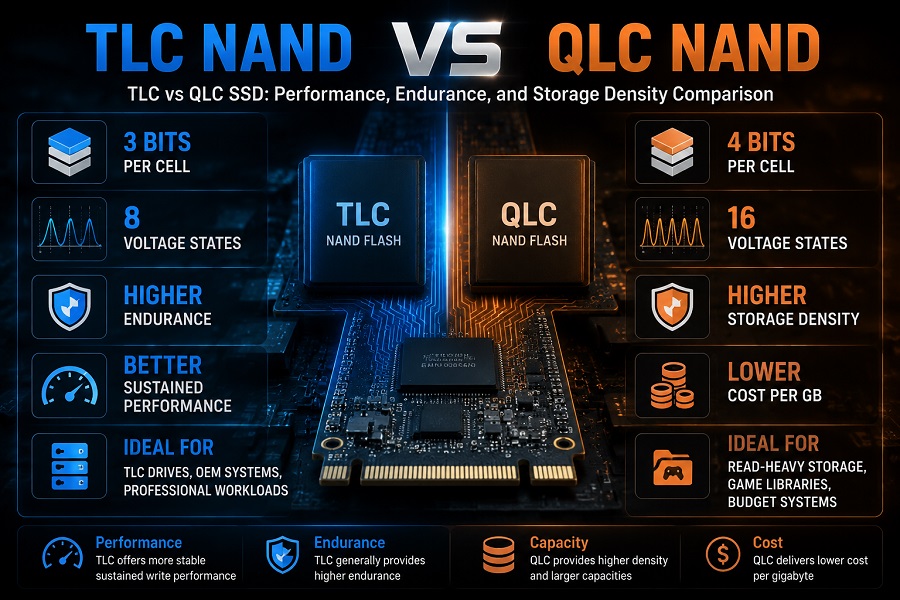
TLC SSDs generally provide better endurance, more consistent sustained write performance, and are widely used for operating systems, professional applications, and OEM systems where long-term stability is important.
QLC SSDs provide higher storage density and lower cost per gigabyte. They are a practical choice for read-intensive applications such as game storage, content libraries, and cost-sensitive consumer systems.
For SSD manufacturers and OEM customers, NAND selection is usually based on application requirements, including workload, expected service life, and required performance stability.
There is no single NAND type that is best for every application. The right choice depends on workload, performance requirements, and product lifetime expectations.
Why TLC vs QLC Matters for SSD Selection
When selecting an SSD, many buyers focus on peak benchmark numbers such as "7,000 MB/s sequential read speed".
However, peak performance only represents a short test scenario. In real applications, SSD performance can change depending on:
- Continuous write workload
- NAND flash type
- Controller design
- Firmware optimization
- Thermal conditions
- Over-provisioning capacity
Modern SSDs use 3D NAND flash technology, and TLC NAND and QLC NAND represent different approaches to balancing performance, endurance, storage density, and cost.
For OEM projects and system integration, the NAND technology inside the SSD plays an important role in long-term performance and reliability.
However, NAND selection is only one part of choosing the right SSD. Buyers also need to consider SSD form factor, interface compatibility, controller design, thermal management, and workload requirements. For a complete selection framework, see our SSD Buying Guide 2026: How to Choose the Right SSD for PC, Laptop, and OEM Applications.
This is where TLC and QLC NAND create different engineering trade-offs.
At first glance, QLC appears attractive because it provides more storage capacity at a lower manufacturing cost. However, storing more bits in each NAND cell introduces additional challenges in endurance, write performance, and error management.
TLC vs QLC NAND: What Changes Inside the Flash Cell?
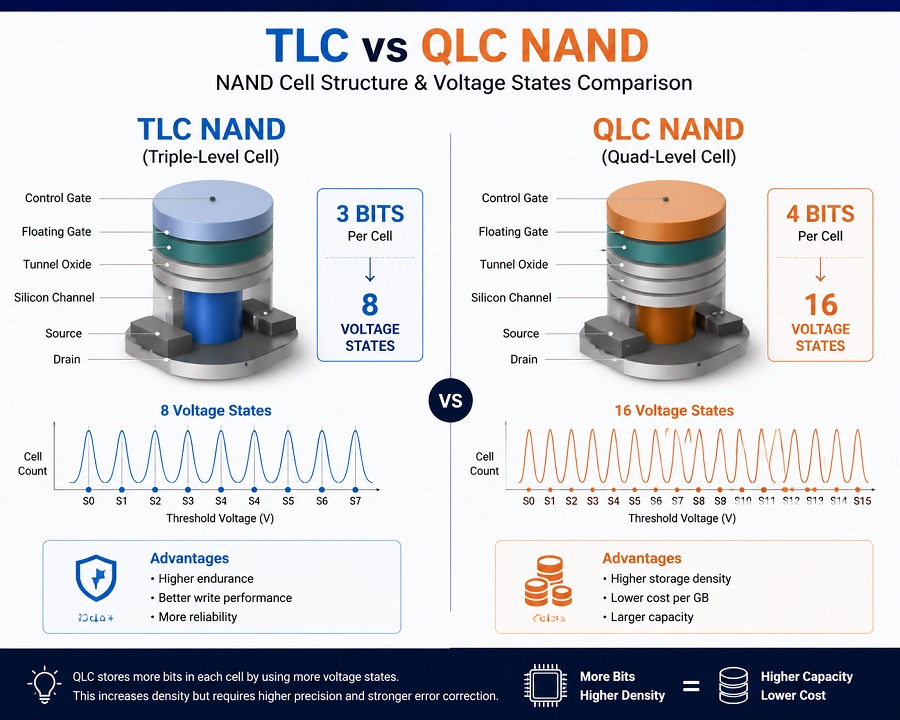
The main difference between TLC and QLC SSDs is the amount of data stored in each NAND cell.
TLC NAND (Triple-Level Cell)
TLC stores:
3 bits per cell
This means each cell represents:
2³ = 8 voltage states
The controller manages eight different voltage levels to store data.
QLC NAND (Quad-Level Cell)
QLC stores:
4 bits per cell
This increases storage density to:
2⁴ = 16 voltage states
The controller must distinguish between twice as many voltage levels within the same physical cell range.
A simple way to understand this difference:
Imagine measuring the same distance with a ruler. If you divide that ruler into more measurement points, each point becomes closer together and requires higher accuracy.
The same principle applies to NAND flash.
With QLC NAND, the smaller voltage margins require:
- More precise programming
- Additional verification processes
- Stronger error correction
- More advanced firmware management
The result is higher storage density but increased engineering complexity.
Technical Deep Dive:
Managing these razor-thin voltage margins requires real-time coordination from the flash controller. To learn how the controller uses multi-stage LDPC error correction engines and FTL mapping to keep high-density NAND stable, read our full guide: How SSD Controllers Work: Speed, Thermal & Lifespan.
SSD Endurance: Why TLC Usually Lasts Longer
SSD endurance is commonly measured by Program/Erase (P/E) cycles.
Every time NAND cells are written and erased, the electrical characteristics of the cells gradually change.
Typical Endurance Characteristics
| NAND Type | Endurance Characteristics |
|---|---|
| TLC NAND | Generally higher endurance and better write tolerance |
| QLC NAND | Generally lower endurance due to higher storage density |
These characteristics may vary depending on:
- NAND generation
- Manufacturing process
- Controller design
- Firmware optimization
- Over-provisioning design
Actual endurance depends on many factors, including:
- NAND generation
- Flash quality
- Controller technology
- Firmware algorithms
- User workload
For example:
A storage device mainly used for reading large files may experience relatively low wear.
However, applications involving:
- Frequent file updates
- Database logging
- Operating system background writes
- Continuous data recording
will place more pressure on NAND endurance.
For these workloads, TLC SSDs usually provide more endurance margin.
SSD lifespan is not determined by NAND type alone. Controller technology, firmware algorithms, workload conditions, and thermal management also affect long-term reliability. Understanding metrics such as SSD TBW is also important when evaluating SSD endurance for long-term applications.
TLC vs QLC SSD Engineering Comparison
| Feature | TLC SSD | QLC SSD |
|---|---|---|
| Bits per Cell | 3 Bits / Cell (8 States) | 4 Bits / Cell (16 States) |
| Storage Density | Lower | Higher |
| Endurance | Higher | Lower |
| Write Consistency | Better sustained performance | More affected after cache exhaustion |
| ECC Requirement | Standard LDPC error correction | Higher error correction requirements |
| Cost per GB | Higher | Lower |
| Best Applications | OS drives, OEM systems, professional workloads | Read-heavy storage, game libraries, budget systems |
Engineering Note on Cache Design:
While NAND selection (TLC vs. QLC) determines the raw storage density and physical cell endurance, the drive’s controller cache design plays an equally critical role in real-world responsiveness and sustained write stability. To understand how onboard DRAM and Host Memory Buffer (HMB) technologies complement NAND choices, read our full technical breakdown: DRAM vs DRAM-less SSD: Performance, Endurance, and Buying Guide (2026).
Sustained Write Performance: What Happens After SLC Cache Exhaustion?
Modern SSDs use SLC cache technology to improve short-term performance.
During normal benchmark tests or small file transfers, both TLC and QLC SSDs can deliver very high speeds because part of the NAND operates temporarily as SLC.
However, large continuous workloads tell a different story.
Examples include:
- Large video file transfers
- System image deployment
- SSD cloning
- Enterprise batch installation
When the SLC cache becomes full, the SSD must write directly to native TLC or QLC NAND.
TLC SSD Sustained Write Performance
TLC NAND usually maintains stronger sustained write performance after cache exhaustion.
QLC SSD Sustained Write Performance
QLC SSD performance can decrease significantly depending on:
- NAND configuration
- Controller design
- Cache size
- Firmware optimization
This does not mean QLC is unsuitable.
It means QLC should be matched with the correct workload.
For OEM customers deploying hundreds or thousands of systems, predictable performance is often more important than peak benchmark speed.
Why NAND Quality Control Matters in SSD Manufacturing
NAND selection is only the starting point of SSD reliability engineering.
A stable SSD requires cooperation between:
- NAND flash
- Controller
- Firmware
- PCB design
- Testing process
Higher-density NAND such as QLC requires careful validation because smaller voltage margins leave less tolerance for signal variation.
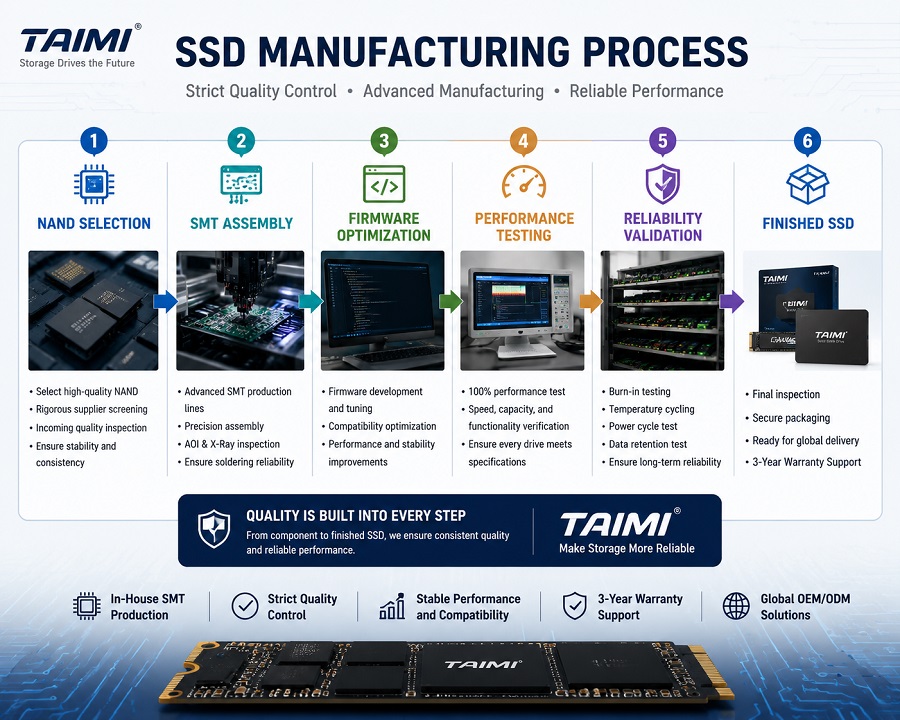
A reliable SSD production process typically includes:
NAND Screening
Selecting qualified NAND components and ensuring consistency between production batches.
Firmware Optimization
Adjusting firmware algorithms for better performance, error management, and long-term stability.
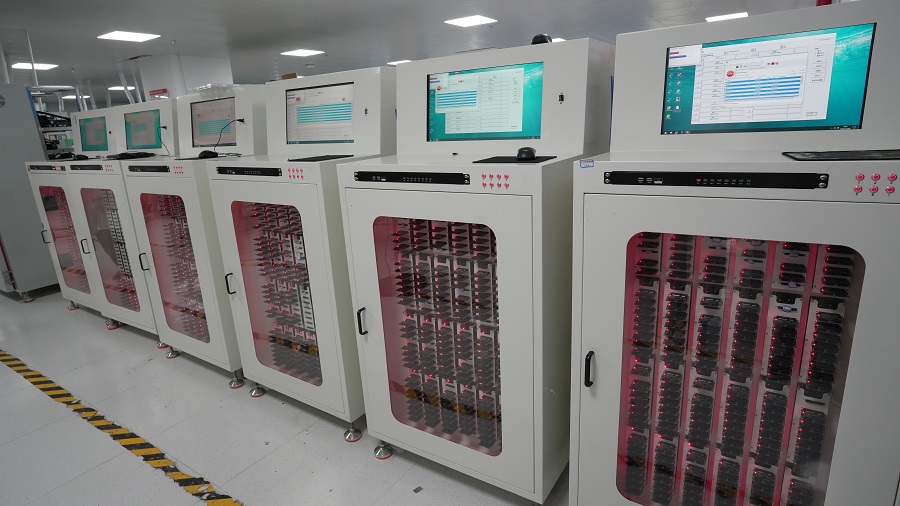
Reliability Testing
Testing SSDs under different conditions, including:
- Temperature variation
- Power cycles
- Continuous workloads
- Data retention requirements
For OEM customers, manufacturing control is often just as important as the NAND type itself.
These manufacturing steps are also critical in the complete SSD production process, from NAND selection to final product validation, including SMT assembly, firmware optimization, and reliability testing.
How Taimi Evaluates TLC and QLC NAND for SSD Production
For SSD manufacturers, NAND selection is not only about choosing TLC or QLC.
Before mass production, engineers evaluate:
- NAND consistency across different batches
- Controller compatibility
- Firmware tuning capability
- Thermal performance
- Target application requirements
- Expected product lifecycle
A NAND solution that performs well in laboratory benchmarks may not always be the best choice for long-term commercial deployment.
For this reason, SSD manufacturers must balance:
- Performance
- Reliability
- Cost
- Application requirements
As a consumer SSD manufacturer, Taimi selects NAND solutions based on application requirements rather than cost alone.
OEM SSD NAND Selection Factors
During SSD development, engineers consider:
- Target workload
- Expected product lifetime
- Performance requirements
- Thermal environment
- Cost objectives
- Controller compatibility
- NAND availability
- Firmware optimization requirements
TLC vs QLC SSD Selection Guide for OEM Applications
| Application | Recommended NAND |
|---|---|
| OEM Desktop Systems | TLC |
| Mini PCs | TLC / QLC |
| Consumer PCs | TLC / QLC |
| Gaming PCs | TLC Preferred |
| Video Editing Systems | TLC |
| Embedded Consumer Devices | TLC |
| Large Capacity Storage | QLC |
| M.2 NVMe Consumer SSD | TLC Preferred |
| SATA SSD Upgrade Systems | TLC / QLC depending on workload |
Evaluating TLC or QLC NAND options specifically for SATA-based systems or legacy upgrades? Read our complete guide to understand SATA interface bandwidth, form factors, and compatibility: What Is a SATA SSD? Speed, Benefits, Compatibility, and Applications (2026 Guide).
The best NAND choice depends on the final product requirements.
Choosing the Right SSD for Different Applications
Choose TLC SSDs for Operating System Drives
Windows and Linux systems constantly perform background operations such as updates, indexing, and temporary file management.
TLC provides additional endurance and more stable performance for these workloads.
Choose TLC SSDs for Professional Workloads
Applications such as:
- Video editing
- Content creation
- Data processing
benefit from stronger sustained write performance.
Choose TLC SSDs for OEM System Deployment
For commercial products where reliability and predictable performance matter, TLC is often the preferred choice.
Choose QLC SSDs for Game Storage
Most gaming workloads are primarily read-focused after installation.
Choose QLC SSDs for Content Storage and Cost-Sensitive Systems
When capacity and price efficiency are the main priorities, QLC provides advantages.
FAQ: TLC vs QLC SSD
Q1: Is TLC SSD better than QLC SSD?
Not always.
TLC provides better endurance and sustained write performance, while QLC offers better storage density and lower cost.
In real SSD projects, NAND selection is usually determined by the actual usage scenario rather than specifications alone.
Q2: Can QLC SSD be used as a Windows boot drive?
Yes, but TLC is generally a better option for primary system drives.
Operating systems generate frequent background writes, and TLC provides more endurance headroom for long-term use.
Q3: Do QLC SSDs make games slower?
Usually not.
Game loading is mainly a read operation, and modern QLC SSDs can provide fast read performance.
The difference becomes more noticeable during large game installations or updates.
Q4: Why are QLC SSDs cheaper?
QLC stores four bits per NAND cell instead of three. This increases storage density and allows manufacturers to produce more capacity from the same silicon area, reducing the cost per gigabyte.
Q5: Should OEM projects choose TLC or QLC SSDs?
It depends on the application.
Projects requiring long service life, stable performance, and frequent write operations usually benefit from TLC NAND.
Projects focused on storage capacity and cost efficiency may consider QLC NAND.
Q6: Which NAND type is better for OEM SSD projects?
For OEM SSD projects, TLC NAND is usually preferred when customers require:
- Stable performance
- Longer product lifecycle
- Frequent system updates
QLC NAND can be considered when capacity and cost efficiency are the main priorities. The final choice depends on application requirements, not simply NAND type.
Q7: Does TLC SSD always outperform QLC SSD?
Not always.
SSD performance depends on multiple factors, including:
- NAND type
- Controller design
- Firmware optimization
- Cache strategy
- Workload conditions
A well-designed QLC SSD can still provide excellent performance for read-intensive applications.
Q8: Is TLC SSD better for OEM applications?
In many OEM applications, TLC SSDs are preferred because they provide better endurance, stable write performance, and more predictable long-term behavior.
However, the final NAND selection depends on workload, cost requirements, and product lifecycle expectations.
Final Recommendation
TLC and QLC SSDs are designed for different purposes.
For OEM systems, consumer devices, and performance-sensitive products, TLC SSDs usually provide a better balance of endurance and consistency.
For read-heavy applications where storage capacity and cost are the priority, QLC SSDs remain a practical solution.
The key is not choosing the "fastest" SSD on a benchmark chart, but selecting the NAND technology that matches the real workload.
At Taimi, SSD solutions are developed by balancing NAND selection, firmware optimization, manufacturing control, and customer application requirements.
With in-house SMT production, NAND evaluation, firmware validation, and SSD testing capabilities, Taimi provides reliable SSD solutions for OEM customers and system integrators.
Related Products
Recommended Articles
SSD Manufacturing Quality Control: Inside Taimi SMT Production Process
2026-07-24
More
Why an SSD Is Detected in BIOS but Not Showing in Windows
2026-07-22
More
From NAND Flash to Finished SSD: Inside the SSD Manufacturing and Testing Process
2026-07-20
More
PCIe 4.0 vs. 3.0: An Engineering Reality Check on Performance
2026-07-08
More
PCIe vs. SATA SSD: A 2026 Engineer’s Guide to Storage Upgrades
2026-07-02
More
PCIe 4.0 vs. SATA SSD: Choosing the Right Storage for OEM Projects (No Fluff)
2026-06-26
More
7000MB/s Peak Read vs. Sustained Write Lines in 4K Video Workflows
2026-04-24
More