













For system integrators, custom PC builders, and volume assemblers, choosing an SSD supplier involves much more than finding the lowest unit price. When solid-state drives are purchased in bulk, the supplier can directly affect product consistency, system compatibility, production schedules, warranty handling, and the overall cost of PC manufacturing.
A suitable SSD supplier for PC builders should provide appropriate drive specifications for your target systems, consistent batch quality, reliable supply, sample validation support, and practical support for repeat orders.
This guide explains how PC builders can evaluate SSD suppliers for bulk purchasing, PC assembly, and OEM projects, with a focus on product specifications, compatibility, testing, supply stability, and total procurement cost.
Quick Answer: What Should PC Builders Look for in an SSD Supplier?
The best SSD supplier for PC builders is not necessarily the supplier with the lowest quotation. A suitable supplier should provide compatible SSD configurations, consistent batch quality, reliable supply, sample validation, and clear warranty support rather than competing on unit quotation alone.
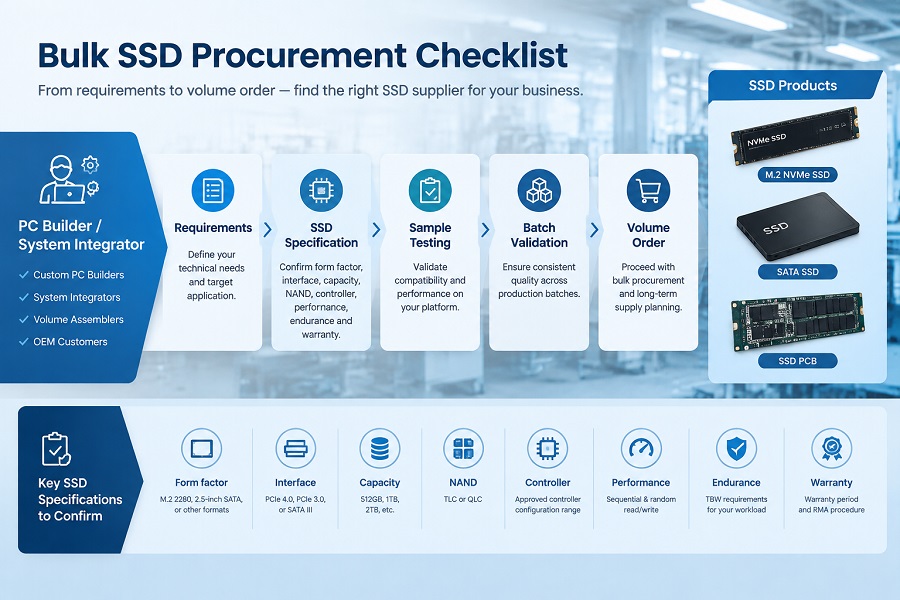
Before placing a bulk order, define your technical requirements for:
- Form factor: M.2 2280, 2.5-inch SATA, or another required format
- Interface: PCIe 4.0, PCIe 3.0, or SATA III
- Capacity: Required capacity range such as 512GB, 1TB, or 2TB
- NAND type: TLC or QLC, depending on the application
- Controller: Required controller configuration or approved configuration range
- Performance: Sequential and random read/write requirements
- Endurance: TBW requirements for the intended workload
- Warranty: Warranty period and RMA procedure
- OEM requirements: Private labeling, packaging, or serial number requirements
After defining these parameters, ask the supplier to provide samples and confirm whether the same configuration can be maintained for future production batches.
Why SSD Batch Consistency Matters for Volume PC Assembly
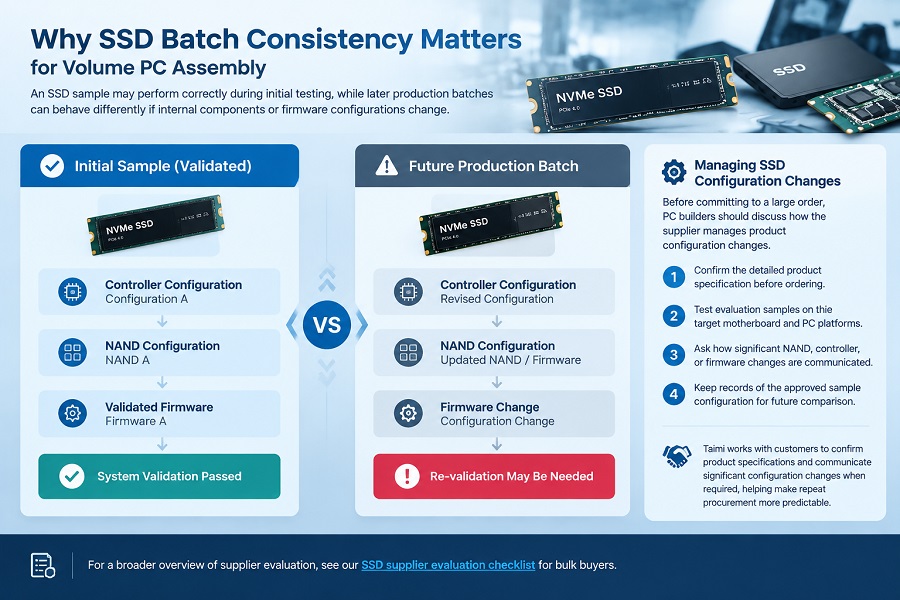
For PC builders purchasing SSDs in volume, one of the most important considerations is batch consistency. An SSD sample may perform correctly during initial testing, while later production batches can behave differently if internal components or firmware configurations change.
Changes in NAND flash configuration, controller revisions, firmware, or other components do not automatically mean that a drive is defective. However, significant configuration changes can affect performance, compatibility, thermal behavior, or the way a drive works with a specific PC platform.
| Initial Sample (Validated) | Future Production Batch |
|---|---|
| Controller Configuration | Revised Configuration |
| NAND Configuration | Updated NAND / Firmware |
| Validated Firmware | Configuration Change |
| System Validation Passed | Re-Validation May Be Needed |
Managing SSD Configuration Changes
Before committing to a large order, PC builders should discuss how the supplier manages product configuration changes.
- Confirm the detailed product specification before ordering.
- Test evaluation samples on the target motherboard and PC platforms.
- Ask how significant NAND, controller, or firmware changes are communicated.
- Keep records of the approved sample configuration for future comparison.
Taimi works with customers to confirm product specifications and communicate significant configuration changes when required, helping make repeat procurement more predictable.
For a broader overview of supplier evaluation, see our SSD supplier evaluation checklist for bulk buyers.
Manufacturer vs. Distributor vs. Trading Supplier
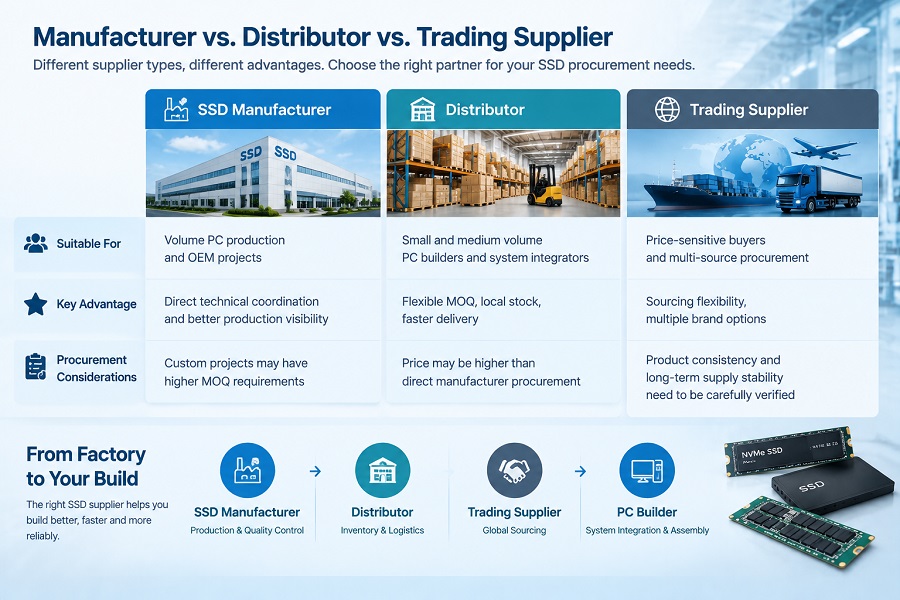
The type of supplier you choose can affect pricing, technical communication, customization, inventory availability, and long-term supply planning.
| Supplier Type | Suitable For | Key Advantage | Procurement Considerations |
|---|---|---|---|
| SSD Manufacturer | Volume PC production and OEM projects | Direct technical coordination and better production visibility | Custom projects may have higher MOQ requirements |
| Distributor | Small to medium PC builders | Local inventory and flexible order quantities | Customization and direct engineering support may be limited |
| Trading Supplier | Buyers comparing multiple product categories | Broad sourcing flexibility | Factory visibility and configuration control can vary |
Standardize Your SSD Specification Before Requesting Quotes
A standardized specification sheet makes it easier to compare different SSD suppliers on an equivalent basis. Instead of asking for a general product such as "1TB NVMe SSD," define the technical requirements before requesting quotations.
====================================================================
BULK SSD PROCUREMENT SPECIFICATION TEMPLATE
====================================================================
Form Factor:        M.2 2280 / 2.5-inch
Interface:          PCIe 4.0 NVMe / PCIe 3.0 NVMe / SATA III
Capacity:           512GB / 1TB / 2TB
NAND Type:          TLC / QLC
Controller:         Required or approved configuration
Performance:        Sequential Read/Write targets
Endurance:          Required TBW
Warranty:           Required warranty period
Packaging:          ESD Bulk Tray / Retail Packaging
Labeling:           Standard Brand / OEM Private Label
For PCIe-based products, interface generation and motherboard support should also be considered. Our PCIe 4.0 vs. 3.0 engineering guide explains why the interface specification alone does not determine real-world system performance.
Consumer-Grade Storage Solutions for PC Assembly
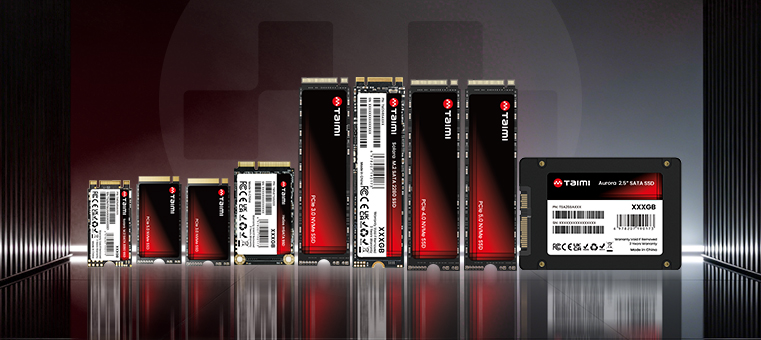
Different PC configurations require different storage interfaces, capacities, and performance levels. Taimi provides consumer-grade SSD and storage solutions for PC builders, regional distributors, system integrators, and OEM bulk projects.
| Product Series | Interface | Capacity / Range | Typical Application |
|---|---|---|---|
| PCIe 4.0 NVMe SSD Series | PCIe 4.0 | Product-dependent | Gaming desktops and performance-oriented PCs |
| PCIe 3.0 NVMe SSD Series | PCIe 3.0 | Product-dependent | Mainstream desktops and office PCs |
| Qiming 2.5" SATA SSD Series | SATA III | 128GB – 2TB | Desktop PCs, laptops, and legacy upgrades |
| M.2 SATA SSD Series | SATA | Product-dependent | Compact PC and SFF systems |
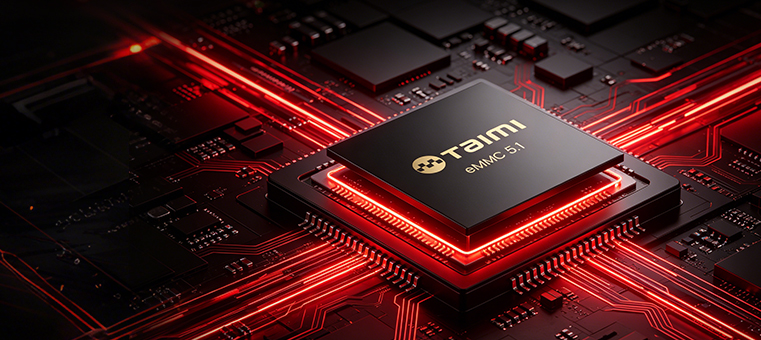
| eMMC Storage Series | eMMC 5.1 | 32GB – 256GB | Consumer electronics and embedded devices |
Actual NAND flash, controller, firmware, speed, endurance, and capacity specifications should always be confirmed against the specific product configuration before mass production.
If your project uses M.2 NVMe drives, our M.2 SSD compatibility guide covers form factors, interfaces, keys, and motherboard compatibility considerations.
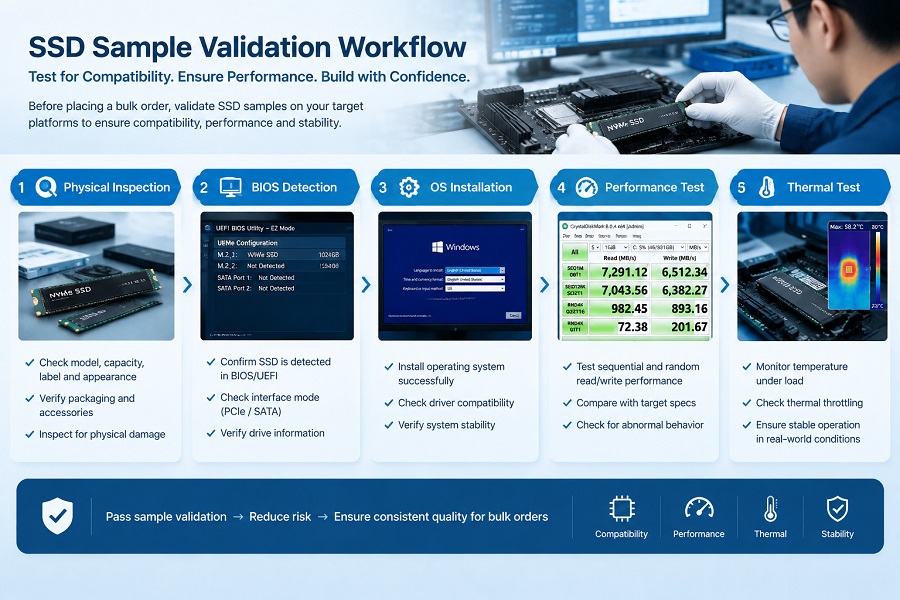
Recommended SSD Sample Validation Workflow
Before placing a volume order, PC builders should test evaluation samples in representative hardware rather than relying only on a product specification sheet.
1. Physical Inspection
- Verify form factor dimensions and connector alignment.
- Check PCB condition and label information.
- Confirm packaging and ESD protection requirements.
2. BIOS and OS Deployment Compatibility
- Test samples on the motherboard platforms used in your PC builds.
- Confirm UEFI/BIOS recognition.
- Verify partition creation and operating system installation.
- Test boot cycles after OS deployment.
- Check compatibility with your disk cloning or master-image workflow.
3. Thermal and Sustained Performance Testing
- Measure sequential and random read/write performance.
- Monitor drive temperature under sustained workloads.
- Check write performance after the SLC cache buffer is filled.
- Compare results between multiple samples rather than testing only one drive.
Testing multiple samples is particularly useful for identifying unexpected differences between units before moving into volume production.
For a deeper understanding of SSD internal performance factors, see our SSD controller engineering guide .
Understanding Total Cost of Ownership in Bulk SSD Sourcing
Comparing suppliers only by their initial unit quotation can hide additional procurement costs. PC builders should consider the broader cost of purchasing, validating, deploying, and supporting the SSDs.
Total Procurement Cost = Unit Price + Logistics + Validation Cost + Inventory Cost + Warranty Support
A supplier with a slightly higher unit price may still be more cost-effective if the supplier provides consistent configurations, predictable delivery, adequate sample support, and efficient warranty handling.
The goal of bulk procurement is therefore not simply to obtain the lowest quotation. It is to establish a storage supply chain that remains predictable as production volume increases.
Key Questions to Ask an SSD Supplier Before Volume Purchasing
- What controller and NAND configuration is used for this SSD model?
- Can evaluation samples be provided for compatibility and performance testing?
- How are significant NAND, controller, or firmware changes communicated?
- What are the standard lead times and MOQs for bulk orders and repeat replenishment?
- What OEM private-label and packaging options are available?
- What is the standard warranty period and RMA procedure?
Frequently Asked Questions
What is the best SSD supplier for PC builders?
The best SSD supplier depends on your production volume, technical requirements, target systems, and procurement priorities. A suitable supplier should provide compatible configurations, consistent batch quality, reliable delivery, and clear technical and warranty support.
Should PC builders purchase directly from SSD manufacturers?
Direct factory sourcing can be suitable for PC builders with recurring bulk requirements or OEM projects. It can provide clearer specification communication, direct technical coordination, and better visibility into production and supply planning.
What warranty period is common for bulk consumer SSDs?
Warranty periods vary by manufacturer and product series. A three-year warranty is commonly offered for many consumer-grade SSD products, but buyers should always confirm the exact warranty terms before placing an order.
Why is SSD sample testing necessary before a volume order?
Sample testing allows PC builders to verify physical fit, BIOS detection, operating system installation, master-image deployment, thermal behavior, and sustained performance on their actual hardware before committing to volume production.
Can SSD suppliers support OEM or private-label requirements?
Many SSD manufacturers support OEM requirements such as custom drive labels, serial number tracking, customized packaging, and bulk ESD tray packaging. MOQ, lead time, and available customization options should be confirmed before production.
Final Takeaway
Choosing an SSD supplier for PC builders requires more than comparing unit prices. Product specifications, system compatibility, batch consistency, supply stability, sample validation, and warranty support all contribute to the long-term procurement cost.
For smaller PC builders, flexible order quantities and product availability may be the main priorities. For larger system integrators and OEM projects, configuration consistency, technical validation, and reliable repeat supply become increasingly important.
By standardizing your SSD requirements, testing samples on representative systems, and evaluating suppliers based on total procurement cost, you can build a more reliable storage supply chain for ongoing PC production.
Looking for Bulk SSD Solutions for PC Assembly?
If you are evaluating SSD configurations for PC building, system integration, distribution, or OEM projects, you can review Taimi's consumer-grade SSD and storage solutions or contact our team to discuss your requirements.
Contact Taimi