
Company Introduction
More














How to Choose a PCIe 3.0 SSD Supplier for Bulk Orders
Share:
Quick Answer
Choosing a PCIe 3.0 SSD supplier for bulk orders requires more than comparing unit prices or advertised peak read/write speeds. High-volume buyers should evaluate real-world performance, controller and NAND flash configurations, platform compatibility, sustained write behavior, sample quality, batch consistency, production testing, warranty terms, and technical support before committing to a large procurement project.
For PC builders, system integrators, distributors, and OEM projects, a dependable purchasing workflow usually follows these steps:
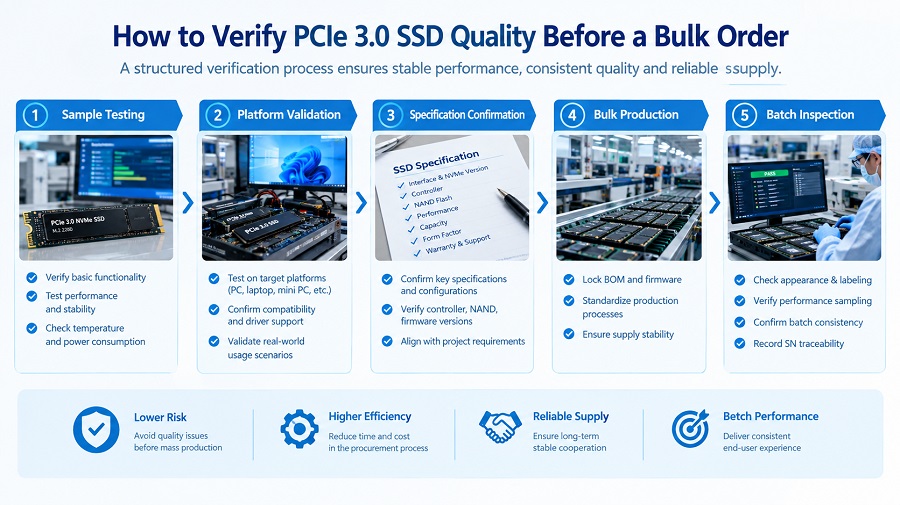
Sample Testing → Platform Validation → Specification Confirmation → Bulk Production → Batch Inspection
PCIe 3.0 remains a practical, stable, and cost-effective interface for many system deployments. PCIe 3.0 operates at 8.0 GT/s and supports interoperability across PCIe generations, subject to the capabilities of the host platform and connected device.
Why Are PCIe 3.0 SSDs Still Used in Bulk Projects?
While PCIe 4.0 and newer interfaces offer higher peak bandwidth, not every commercial PC or OEM project requires the fastest interface on the market. For bulk SSD buyers, selecting the right drive comes down to target platform compatibility, required performance, overall system cost, and supply consistency.
Wide Compatibility With Commercial Platforms
PCIe 3.0 has been widely integrated across PC platforms and remains highly relevant for systems designed around PCIe 3.0 connectivity. It offers dependable storage performance for:
- Office and commercial PC deployments
- Entry-level and mainstream desktop systems
- Laptop upgrade and mini PC projects
- System integrator (SI) turnkey builds
- Cost-sensitive desktop and embedded configurations
- OEM projects built on existing motherboard platforms
When a project relies on a PCIe 3.0 platform, choosing a well-validated PCIe 3.0 NVMe SSD is often more practical than paying a premium for a newer generation interface that the host system cannot fully utilize.
If you are comparing PCIe generations for a specific project, see our PCIe 4.0 vs. 3.0: An Engineering Reality Check on Performance for a more detailed look at the practical differences between the two interfaces.
Cost-to-Performance Efficiency
For large-volume orders, controlling the overall bill-of-materials (BOM) cost is critical. A procurement team needs to balance:
- SSD unit price
- Application performance
- System cooling requirements
- Long-term supply stability
- Warranty and after-sales support
A reliable PCIe 3.0 SSD delivers the bandwidth needed for daily business computing without generating unnecessary cost or heat overhead.
Consistency Over Synthetic Benchmarks
When ordering hundreds or thousands of SSDs for a single PC assembly run, a single impressive benchmark result on a datasheet is not enough. Bulk buyers prioritize:
- Compliance with the agreed specification across all units
- Repeatable performance between test samples and mass batches
- Stable controller and NAND flash configurations
- Predictable firmware behavior under continuous load
- Verified compatibility across target motherboard platforms
For volume procurement, batch consistency is a fundamental part of overall product quality.
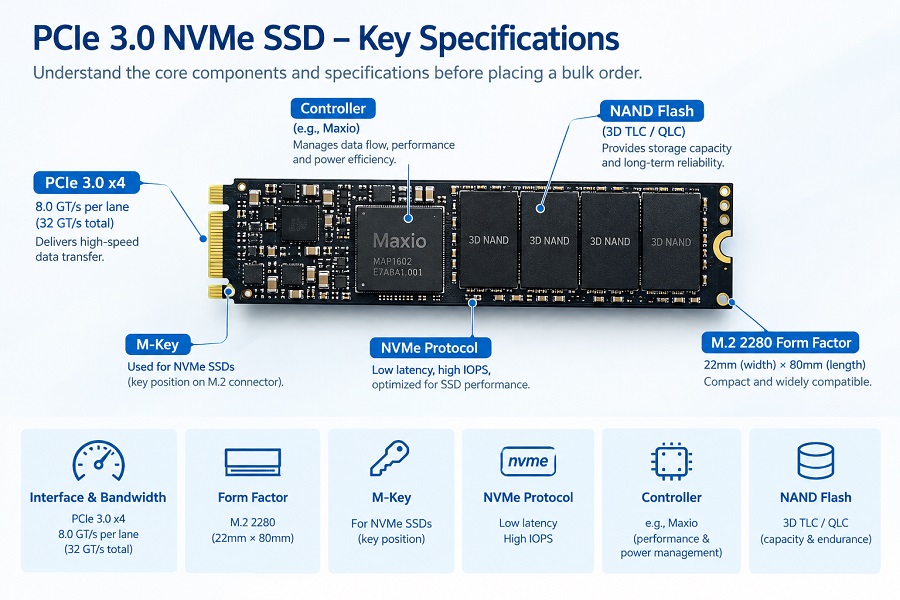
What Specifications Should You Check Before Ordering PCIe 3.0 SSDs?
Before requesting quotations from a PCIe 3.0 SSD manufacturer or bulk SSD supplier, buyers should define their technical requirements clearly.
| Key Specification | What Bulk Buyers Should Check |
|---|---|
| Interface & NVMe Version | Confirm PCIe 3.0 x4 link support, M.2 form factor, and NVMe protocol compatibility. |
| Controller Architecture | Identify the controller supplier (e.g., Maxio) and thermal throttling profile. |
| NAND Flash Type | Verify NAND type (3D TLC vs. QLC), grade, flash source, and supply continuity. |
| Sequential Performance | Check actual tested read/write speeds across different capacities rather than max theoretical numbers. |
| Random Performance | Evaluate 4K random read/write IOPS and system responsiveness under daily workloads. |
| Sustained Write Speed | Review write behavior and thermal stability after the initial SLC cache is exhausted. |
| Capacity & Usable Space | Confirm labeled capacity such as 256GB, 512GB, 1TB, or 2TB and expected usable space. |
| Form Factor & Compatibility | Verify M.2 module dimensions (2280), keying (M-Key), host thermal fit, and BIOS detection. |
Sequential Read and Write Speed
Sequential speeds are typically the most visible performance metrics. However, advertised speeds should not be evaluated in isolation. Actual read and write rates vary depending on drive capacity, NAND flash layout, controller type, firmware tuning, test software, and host platform hardware.
Commercial PCIe 3.0 NVMe SSDs show varying sequential throughput across different capacity tiers. For this reason, buyers should request actual sample test reports rather than relying solely on marketing datasheets.
Depending on the exact controller and NAND configuration, Taimi PCIe 3.0 SSDs can reach up to 3,000 MB/s sequential read and 2,900 MB/s sequential write speeds.
Random Performance and 4K IOPS
While sequential speed matters for transferring large contiguous files, random read and write performance affects operating system responsiveness, application loading times, and multitasking smoothness. A reliable PCIe 3.0 SSD supplier should be able to provide 4K random read/write performance data under clearly defined test conditions.
Sustained Write Performance
Evaluating sustained write behavior is a critical step in PCIe 3.0 SSD bulk procurement. Many consumer SSDs achieve high peak write speeds during short benchmark runs due to temporary SLC caching. Once a large data file fills the cache, write speeds can drop significantly.
For projects involving mass system imaging, large file transfers, or OS deployment, buyers should ask suppliers:
- How long is the continuous write test duration?
- What write speed is maintained after the SLC cache is exhausted?
- What operating temperature does the drive reach during full-disk writes?
How to Verify PCIe 3.0 SSD Quality Before a Bulk Order
Evaluating datasheets alone cannot replace hands-on testing. Qualified SSD sample testing helps prevent integration issues before starting mass production.
Step 1: Request Pre-Production Samples
Before signing a volume contract with a PCIe 3.0 SSD manufacturer, always evaluate physical samples. Sample validation allows your engineering team to verify:
- Physical build quality and PCB layout
- BIOS and OS recognition on target systems
- Actual sequential and random performance
- SMART health monitoring reporting
- Thermal behavior under heavy usage
Step 2: Validate on Your Target Host Platform
Test the samples directly on the specific motherboards, laptops, or desktop platforms where the drives will be deployed. Essential checks include:
- Cold boot and warm reboot recognition
- PCIe link negotiation speed (x4 vs. x2)
- System sleep and wake cycles (S3/S4 state switching)
- OS installation and image cloning speed
- Drive temperature stability during extended operation
For a deeper explanation of why platform validation matters, see our SSD Not Detected in BIOS? What SSD Compatibility Testing Reveals.
Step 3: Verify Factory Testing Standards
Ask the SSD manufacturer how finished drives are tested on the production line. Reliable quality control processes include:
- Automated Optical Inspection (AOI) & X-ray checks: Ensuring solder joint integrity on SMT lines.
- Full-Drive Testing: Testing drive read/write integrity across the accessible storage area according to the manufacturer's production test process.
- High-Temperature Burn-In: Stress-testing drives under controlled thermal conditions to identify potential stability issues before shipment.
- Power Cycle & Sleep State Testing: Ensuring drive stability over repeated system restarts.
For more detail on manufacturer-level stress testing, see SSD Burn-in Testing Explained: How SSD Manufacturers Ensure Reliability Before Shipping.
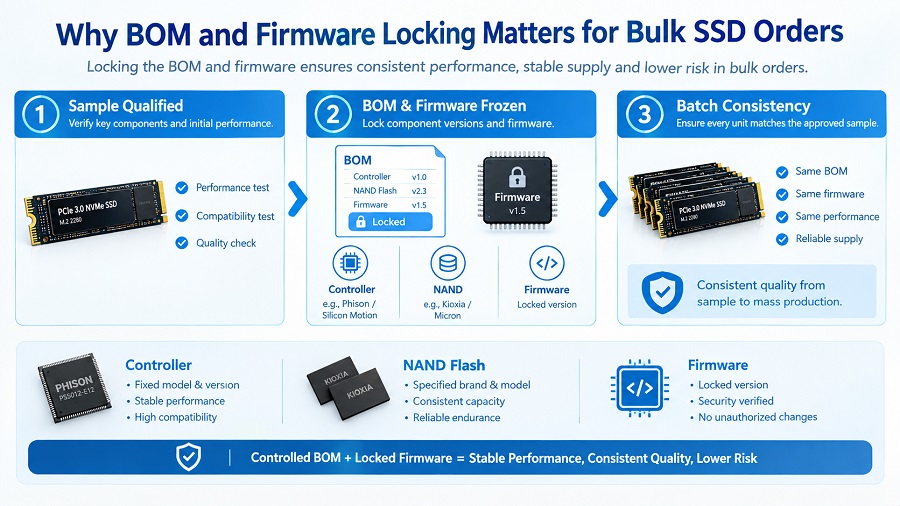
Why BOM and Firmware Locking Matters for Bulk SSD Orders
One of the largest risks in PCIe 3.0 SSD wholesale procurement is unannounced component changes between production runs.
Traditional Sourcing Risk
Sample Qualified → Components Changed in Bulk → Deployment Issues
Taimi OEM Flow
Sample Qualified → BOM & Firmware Frozen → Batch Consistency
The Impact of Silent Component Swaps
If an SSD supplier changes the controller revision, NAND flash generation, or firmware settings without notice, the updated drive may perform differently. This can lead to driver incompatibilities, unexpected thermal throttling, or deployment script errors during mass PC assembly.
Securing a Fixed Specification
For recurring OEM or system integration projects, ask your bulk SSD supplier to freeze the agreed configuration.
At Taimi, we provide strict Bill of Materials (BOM) and Firmware Locking Services for volume customers. Once your engineering team approves the evaluation sample, we lock the controller model (such as Maxio NVMe controllers), NAND flash configuration, PCB layout, and firmware revision for subsequent production orders.
If you are evaluating suppliers for a broader NVMe procurement project, our How to Choose an NVMe SSD Supplier: Bulk Buyer & OEM Guide provides additional criteria for supplier selection and bulk purchasing.
How to Check PCIe 3.0 SSD Batch Consistency
Maintaining strict batch consistency helps ensure that mass-produced SSDs remain within the agreed hardware, firmware, capacity, and performance specifications established during sample approval.
Taimi Batch Consistency Check Points
NAND & Controller Configuration
↓
Locked Firmware Revision
↓
Repeatable Performance Bounds
↓
Consistent Usable Capacity & PCB
↓
Serial Number (SN) Traceability
NAND, Controller, and Firmware Consistency
Re-verify that mass-produced units utilize the same controller and NAND flash combination approved during sample validation. Firmware settings should remain locked to help maintain consistent power management and thermal throttling behavior.
For buyers who want to understand how NAND configuration can affect SSD characteristics, see our What Is NAND Flash? Types, Speed, Endurance, and Applications Explained.
Performance Consistency
Sample drives from mass production runs should be re-tested periodically using the same benchmark setup and thermal conditions. Read/write speeds should remain within the agreed performance tolerance.
Serial Number Traceability
For bulk procurement projects, each SSD should have a unique Serial Number (SN) for production and after-sales traceability. Traceable serial numbers allow the manufacturer to link drives back to production information and test records. This simplifies inventory tracking and can speed up RMA support if issues arise.
OEM Customization for PCIe 3.0 SSD Projects
Working directly with an OEM SSD supplier allows buyers to customize products to fit specific branding and packaging requirements.
Taimi OEM Customization Services
Custom Logo Silk-Screening
↓
Project-Specific Labels
↓
Custom ESD Tray / Packaging
Taimi supports a wide range of OEM/ODM options for system integrators, distributors, and brand partners:
- Custom Logo Printing: High-quality silk-screening directly on the SSD PCB or heat-dissipating label.
- Custom Labels: Branded serial stickers featuring custom part numbers, barcodes, and project-specific labeling requirements.
- Flexible Packaging Options: Anti-static tray packaging for fast assembly line deployment, or custom retail boxes for distribution.
PCIe 3.0 SSD Bulk Procurement Checklist
☐ Interface & Protocol: Verified PCIe 3.0 x4 and NVMe compliance.
☐ Hardware Configuration: Confirmed controller model (e.g., Maxio) and original 3D TLC Flash grade.
☐ Target Platform Validation: Physical samples tested on host motherboards for BIOS, OS, and sleep state compatibility.
☐ Performance Profile: Reviewed actual sequential, random 4K, and sustained write test results.
☐ Factory Quality Control: Confirmed factory burn-in and sector testing procedures.
☐ BOM & Firmware Lock: Secured agreement to lock hardware components and firmware across future orders.
☐ Batch Traceability: Unique serial numbers assigned to every drive for production tracking.
☐ OEM Branding: Custom logo, specialized labeling, and tray or retail packaging requirements finalized.
☐ Warranty & Support: Warranty terms and RMA procedures clearly defined.
Frequently Asked Questions (FAQ)
Is PCIe 3.0 SSD still suitable for bulk orders in 2026?
PCIe 3.0 SSDs remain relevant for many commercial PCs, office desktops, education systems, and cost-sensitive OEM projects, particularly when the target platform is designed around PCIe 3.0 connectivity.
What read/write speeds should I expect from a PCIe 3.0 SSD?
Performance varies by capacity, controller, NAND configuration, and test platform. Mainstream PCIe 3.0 NVMe SSDs typically offer sequential read speeds between 1,800 MB/s and 3,000 MB/s, and sequential write speeds between 1,200 MB/s and 2,900 MB/s.
Why is BOM and firmware locking important when buying SSDs in bulk?
BOM and firmware locking helps ensure that mass-produced SSDs use the controller, NAND flash, and firmware configuration approved during sample testing. This reduces the risk of unexpected compatibility issues, thermal changes, or performance differences across recurring production orders.
What factory testing should a bulk SSD supplier perform?
A reliable SSD manufacturer should have defined production quality-control procedures covering SMT optical inspections (AOI), X-ray checks, burn-in and other production-level stress tests, full-drive testing, and system sleep/wake validation where required by the project.
Can Taimi customize SSD labels and packaging for OEM orders?
Yes. Taimi provides OEM/ODM support, including custom logo silk-screening, tailored serial number labels, customized tray packaging for assembly lines, and retail box packaging.
Partner With a Direct PCIe 3.0 SSD Manufacturer
If you are sourcing PCIe 3.0 SSDs for PC assembly, distribution, or OEM builds, Taimi offers sample testing, BOM locking, mass production, and long-term supply support.
Need PCIe 3.0 SSD Samples for a Bulk or OEM Project?
Discuss your capacity requirements, target platform specs, order volume, and OEM customization needs directly with the Taimi technical team.
Request PCIe 3.0 SSD Samples & OEM Datasheet
Sample testing · OEM support · BOM locking · Bulk production
Related Products
Recommended Articles
What Is an M.2 SSD? Form Factors, Keys & NVMe vs SATA Explained (2026 Guide)
2026-09-18
More
UFS vs eMMC: Speed, Performance, Versions, and Key Differences
2026-09-21
More
How to Choose an SSD Supplier for PC Builders: Bulk Procurement Guide
2026-09-11
More
What Is eMMC? Everything You Need to Know About eMMC Storage
2026-09-04
More
M.2 SSD Compatibility Guide 2026: How to Check NVMe Support Before Buying
2026-08-28
More
How Much SSD Storage Do You Need? 512GB vs. 1TB vs. 2TB SSD
2026-08-24
More
What Is a PCIe SSD? Speed, NVMe, and Compatibility Guide (2026)
2026-08-19
More
What Is a SATA SSD? Speed, Benefits, Compatibility, and Applications (2026 Guide)
2026-08-14
More
What Is an NVMe SSD? Complete Guide to Speed, Gaming Performance, Compatibility, and SSD Selection (2026)
2026-08-12
More