
Company Introduction
More













How to Choose an NVMe SSD Supplier: Bulk Buyer & OEM Guide
Share:
Quick Answer
Choosing an NVMe SSD supplier for bulk orders involves more than comparing unit prices or advertised peak read/write speeds. Professional buyers should evaluate the SSD's PCIe generation, NAND Flash type, controller architecture, DRAM configuration, platform compatibility, thermal behavior under sustained loads, batch-to-batch consistency, quality-control processes, OEM customization options, warranty terms, and long-term supply stability.
For PC builders, system integrators, regional distributors, and OEM clients, requesting engineering samples and running rigorous validation on the target hardware before issuing mass production orders helps verify whether published specifications translate into real-world platform performance and stability.
What Is an NVMe SSD Supplier?
An NVMe SSD supplier provides solid-state drives for applications ranging from desktop PCs and laptops to PC assembly, system integration, distribution, and OEM projects.
Some suppliers operate as trading entities, while manufacturers may have direct control over SMT assembly, firmware requirements, and quality inspection. For bulk buyers, this distinction directly impacts component transparency, firmware lock-in options, test visibility, and long-term supply continuity.
Before selecting a supply partner, procurement and engineering teams should clearly define their project requirements:
- Target capacity & form factor (M.2 2280/2242)
- PCIe generation & performance tier
- Controller architecture & DRAM vs. DRAM-less requirements
- Target motherboard/chipset validation
- Batch consistency and firmware lock requirements
- Expected volume, OEM labeling/packaging, and warranty terms
Key Evaluation Criteria for Bulk NVMe SSD Procurement
| Factor | What to Check | Why It Matters |
|---|---|---|
| NVMe Specifications | PCIe generation, bandwidth, capacities | Ensures hardware matches system performance targets |
| NAND & Controller | NAND architecture, controller model, DRAM presence | Can influence sustained write performance and endurance characteristics |
| Compatibility | BIOS detection, OS recognition, motherboard compatibility | Helps reduce system integration and deployment issues |
| Sample Testing | Real-world benchmark, thermal throttling, stability | Validates factory spec sheets on actual customer platforms |
| Batch Consistency | Unchanged controller, NAND, and firmware across batches | Critical for recurring OEM integration and image deployment |
| Quality Control | SMT inspection, high-temp burn-in, signal integrity | Helps reduce early-life and out-of-box failure risks |
| OEM Support | Custom labeling, packaging design, spec alignment | Aligns with brand identity and project specifics |
| Warranty & RMA | Transparent warranty terms and RMA support | Minimizes total cost of ownership (TCO) |
1. Check NVMe SSD Specifications & Hardware Architecture
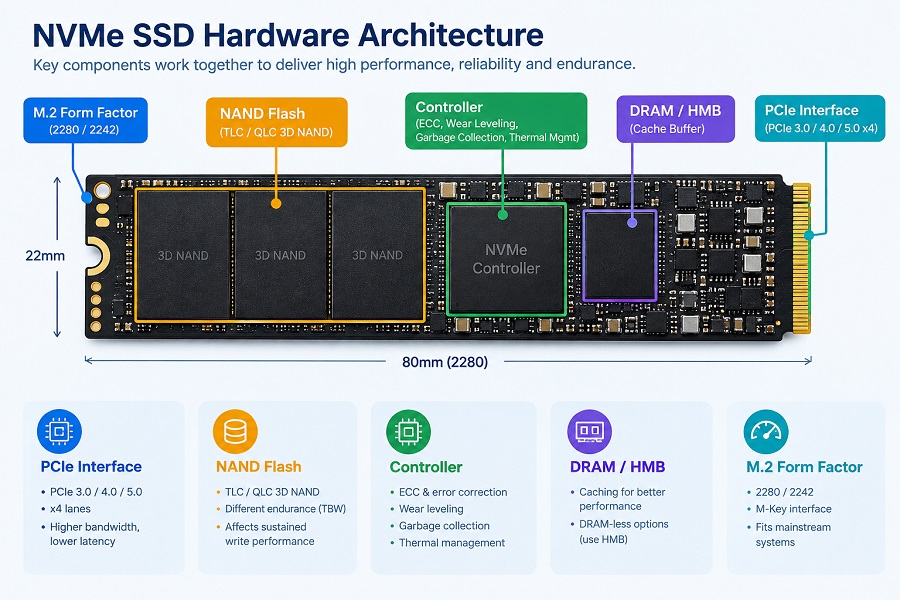
The first step in evaluating a supplier is ensuring their hardware architecture matches your target system's performance and thermal envelope.
PCIe Generation & Bandwidth
NVMe SSDs span across PCIe 3.0, PCIe 4.0, and PCIe 5.0 interfaces. Higher generations offer greater interface bandwidth, but selecting the right drive depends on system thermals, target market cost, and motherboard support.
For mainstream desktop PCs or budget laptop deployments, buyers may prioritize thermal behavior, compatibility, and total system cost over peak benchmark performance, depending on the target workload.
Before ordering, verify:
- PCIe interface & lane count (e.g., PCIe 4.0 x4)
- Peak sequential read/write speeds
- Sustained random IOPS
- Power dissipation and thermal throttling limits
- Target motherboard compatibility
To evaluate the performance trade-offs for mainstream deployments, read our analysis on PCIe 4.0 vs. PCIe 3.0: An Engineering Reality Check.
NAND Flash & Controller Selection
Two SSDs displaying identical top-line sequential speeds can perform differently under sustained PC workloads.
- NAND Flash Type: TLC and QLC 3D NAND offer different endurance (TBW), cost profiles, and sustained write degradation points.
- SSD Controller: The controller manages error correction (ECC), wear leveling, garbage collection, and thermal management. Confirming the specific controller vendor and model helps buyers assess long-term reliability.
- DRAM vs. DRAM-less Design: DRAM-less NVMe SSDs utilizing Host Memory Buffer (HMB) technology can offer a cost-efficient design for many everyday computing workloads. However, heavy workstation workloads or high-depth random I/O applications may require dedicated DRAM buffers.
Learn how controller architecture governs drive stability in How SSD Controllers Work: The Engineering Behind Performance and Lifespan.
2. Verify PCIe Platform & Form Factor Compatibility
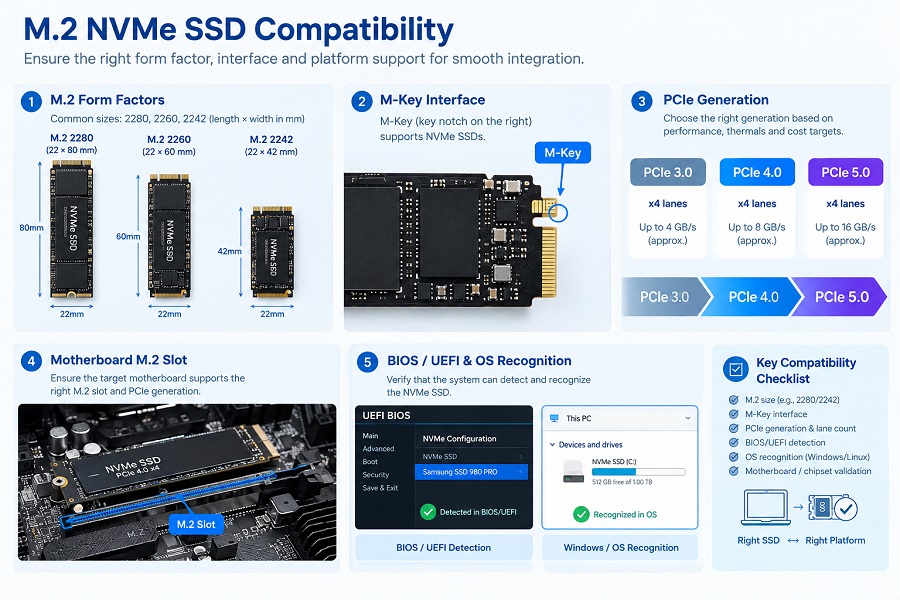
An NVMe drive meeting theoretical benchmark numbers must still achieve consistent detection and stable operation across target hardware configurations.
Physical & Interface Considerations
Verify physical clearance and protocol matching for your target systems:
- M.2 Form Factor: Confirm standard M.2 2280 dimensions and heatsink clearance for space-constrained laptops or compact desktops.
- M.2 Keying: Ensure M-Key alignment for PCIe NVMe operation.
- BIOS & OS Detection: Test drive initialization across target motherboards, OS image builds (Windows, Linux), and storage controller modes (AHCI/RAID/NVMe native drivers).
For a detailed compatibility framework, review our M.2 SSD Compatibility Guide 2026.
3. Require Rigorous Sample Testing Prior to Mass Orders
A datasheet cannot substitute for testing physical engineering samples on your own production rigs.
What to Test in Your Qualification Lab
- Sequential & Sustained Write: Test initial SLC cache performance and sustained write performance after the SLC cache is exhausted.
- Thermal Behavior: Measure idle vs. peak load temperatures under enclosed chassis conditions to verify thermal throttling thresholds.
- Compatibility & Boot Validation: Validate cold boot, sleep/wake cycles, OS installation, and long-duration stability tests.
- SMART Telemetry: Verify proper telemetry output for temperature, health state, wear indicators, and error logs.

4. Evaluate Batch Consistency & Lock-in Requirements
For recurring OEM projects or branded distribution, receiving identical internal hardware across every purchase order is critical.
Why Batch Consistency Matters
In the storage industry, unannounced changes to the NAND flash die, controller stepping, or firmware version can lead to subtle OS image incompatibilities, altered thermal profiles, or unexpected performance drops.
- Specification Lock Agreements: For OEM clients, confirm whether the supplier offers locked Bill of Materials (BOM)—fixing the NAND, controller, and firmware version across agreed production cycles.
5. Inspect Production Capabilities & Quality Control (QC)
Evaluating the supplier’s manufacturing infrastructure helps buyers prevent costly field failures.
Factory QC Standards
Buyers should look for manufacturers with documented quality-control procedures throughout the SMT assembly process, such as:
- Component Screening: Wafer-level and die testing prior to packaging and SMT placement.
- SMT & Optical Inspection: Automated 3D AOI (Automated Optical Inspection) and X-ray inspection for BGA soldering.
- High-Temperature Burn-in Testing: Subjecting SSD batches to elevated temperature burn-in cycles to help identify and screen out early-life failure units.
Understand how factory testing safeguards product consistency in our guide to SSD Burn-in Testing: How Manufacturers Ensure Reliability.

6. Assess OEM Customization, Warranty, and Total Procurement Cost
OEM Customization Capabilities
Depending on the project, OEM discussions may include custom drive labeling, silk screens, retail or bulk packaging, capacity and specification requirements, and applicable firmware requirements.
Warranty & RMA Terms
Always review the supplier's B2B after-sales framework:
- Warranty Coverage: Standard 3-year warranty terms are available for applicable Taimi SSD products, subject to product-specific conditions.
- RMA Process: Verify the procedure for advance replacements, batch defect handling, and technical support responsiveness.
Evaluating Total Cost of Ownership (TCO)
Do not evaluate suppliers purely on the lowest FOB unit price. Factoring in defect rates, shipment lead times, shipping duties, sample validation costs, and local warranty support gives a far clearer picture of long-term supply chain value.
For a broader supplier evaluation framework, see our How to Evaluate an SSD Supplier: A Checklist for Bulk Buyers.
Taimi NVMe SSD Portfolio for OEM & Bulk Buyers
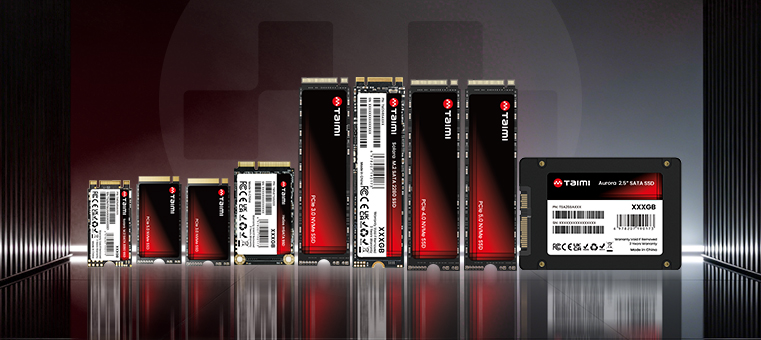
As an integrated storage product manufacturer, Taimi delivers consumer-grade PCIe NVMe SSD solutions engineered for PC builders, system integrators, and global distributors.
- PCIe 4.0 NVMe SSD Series: High-speed PCIe 4.0 storage for mainstream and performance-oriented PC applications, with product specifications varying by model.
- PCIe 3.0 NVMe SSD Series: High-stability, thermal-optimized storage solutions for mainstream PC builds and system integration.
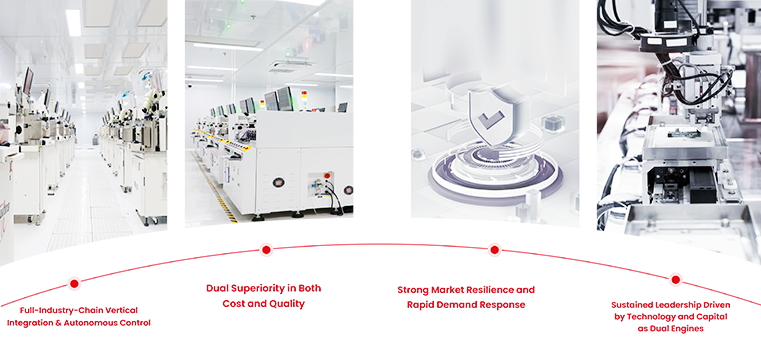
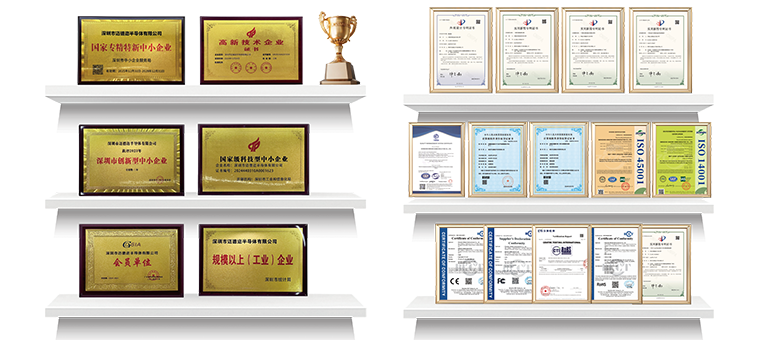
- Manufacturing Excellence: Wafer-level and die testing, automated SMT production, and high-temperature burn-in validation.
- Warranty: Standard 3-year warranty terms are available for applicable Taimi SSD products, subject to product-specific conditions.
NVMe SSD Procurement Checklist for Bulk Buyers
Before finalizing your purchase order, run through this technical checklist:
- ☐ PCIe generation & interface lanes verified
- ☐ M.2 form factor and thermal clearance confirmed
- ☐ Target capacity requirements defined
- ☐ NAND type (TLC/QLC) and controller model confirmed
- ☐ DRAM requirements specified (DRAM-less with HMB vs. dedicated DRAM)
- ☐ Engineering samples performance and thermally stress-tested on host systems
- ☐ BOM lock agreement discussed for OEM batch consistency
- ☐ Factory QC procedures (SMT inspection, Burn-in testing) verified
- ☐ Custom OEM branding, labeling, and packaging defined
- ☐ Warranty terms and RMA procedures documented
Frequently Asked Questions
How do I select the right NVMe SSD supplier for OEM projects?
Evaluate the supplier based on hardware specification clarity, controller/NAND transparency, factory QC procedures (such as high-temperature burn-in testing), sample validation support, batch consistency agreements, and warranty terms.
Why is sample testing necessary before placing a bulk SSD order?
Datasheets only represent theoretical maximums. Testing samples on your target motherboard/system allows engineering teams to verify real-world read/write performance, thermal throttling behavior, BIOS compatibility, and system stability under actual operational workloads.
What is the difference between an SSD trading supplier and a direct manufacturer?
A direct manufacturer may have greater control or visibility over processes such as SMT assembly, component testing, quality inspection, and applicable firmware requirements. Trading suppliers may source finished products from third-party manufacturers, so buyers should verify the actual production and supply-chain arrangements before placing recurring orders.
How does batch consistency affect recurring PC production?
If a supplier changes the underlying NAND flash or controller without notification, recurring production builds may experience OS image deployment errors, altered power draw, or unexpected thermal behavior.
NVMe SSD Solutions for Bulk and OEM Projects
Looking for an NVMe SSD manufacturing partner?
Taimi provides PC builders, system integrators, and international distributors with PCIe SSD solutions, custom OEM labeling, sample qualification, and support for recurring supply requirements.
Contact Taimi today to request engineering samples, product datasheets, and custom bulk quotes.
Request an NVMe SSD QuoteRelated Products
Recommended Articles
How to Choose an SSD Supplier for PC Builders: Bulk Procurement Guide
2026-09-11
More
What Is eMMC? Everything You Need to Know About eMMC Storage
2026-09-04
More
M.2 SSD Compatibility Guide 2026: How to Check NVMe Support Before Buying
2026-08-28
More
How to Evaluate an SSD Supplier: A Checklist for Bulk Buyers
2026-09-02
More
How Much SSD Storage Do You Need? 512GB vs. 1TB vs. 2TB SSD
2026-08-24
More
What Is a SATA SSD? Speed, Benefits, Compatibility, and Applications (2026 Guide)
2026-08-14
More
What Is an NVMe SSD? Complete Guide to Speed, Gaming Performance, Compatibility, and SSD Selection (2026)
2026-08-12
More
What Is a PCIe SSD? Speed, NVMe, and Compatibility Guide (2026)
2026-08-19
More
How SSD Controllers Work: The Engineering Behind SSD Performance, Thermal Throttling, and Lifespan (2026 Guide)
2026-08-07
More